What Does the Bible Mean by Soul and Spirit?
(A Biblical Framework Before the Conclusions)
Author’s Note
Before you read further, a brief word about what this article is and is not.
I am not taking a position here on whether human beings are made up of body and soul, or body, soul, and spirit. I am also not arguing for a particular view of the afterlife. What I am doing is laying out why thoughtful Christians, reading the same Bible, end up in different places on these questions.
My aim is not to settle the debate, but to show where it actually begins. If we do not slow down and let Scripture set the categories, we will keep arguing conclusions without ever addressing the real points of disagreement.
Introduction — Why This Question Has to Be Asked First
Most Christians are very sure they know what the soul is. Ask the question in a church hallway and the answer usually comes quickly. The soul is the part of you that lives on after death. The body dies, but the soul goes to be with God. The spirit is either the same thing, or maybe a higher part of it.
Those answers sound biblical. They feel biblical. But when you start looking for where Scripture actually defines those ideas, things slow down.
The Bible uses the words soul and spirit often. It uses them confidently. What it does not do is stop and explain them the way a theology textbook would. Scripture tells a story. It describes life given by God, life lost through sin, death as an enemy, and resurrection as hope. Along the way, it uses language it assumes its readers understand without needing everything mapped out.
That gap between how Scripture speaks and how we often speak is where confusion enters.
Many of our assumptions about the soul do not come from careful reading of Genesis or the Gospels. They come from sermons we have heard, phrases repeated at funerals, and ideas absorbed over time. By the time we open the Bible, we are often reading it through conclusions we have never examined.
This article is an attempt to slow that process down. Before arguing about what happens after death, we need to ask a more basic question. What does Scripture actually mean when it talks about soul and spirit? And just as important, what does it not say?
Why “Soul” and “Spirit” Are Usually Assumed, Not Examined
Most of us did not arrive at our understanding of the soul by sitting down with a concordance. We inherited it. We learned how to talk about the soul long before we learned how the Bible uses the word.
When Scripture says “soul,” modern readers usually hear “immortal inner self.” When Scripture says “spirit,” we often hear the same thing, just described in more spiritual language. The body, by contrast, gets treated as temporary. Important for now, but not essential in the end.
The problem is not that these ideas are always wrong. The problem is that they are often assumed without being tested against the text.
In the Bible, the soul can be troubled, saved, lost, poured out, and even die. The spirit is given by God, returned to God, strengthened, or crushed. The body is not treated as a shell to escape, but as something God formed, called good, and promised to raise.
Those categories do not line up neatly with the way we often talk.
Man Became a Living Being: Slowing Down in Genesis 2:7
Genesis 2:7 is often quoted quickly and examined briefly. It deserves neither.
“Then Yahweh God formed man of dust from the ground, and breathed into his nostrils the breath of life; and man became a living being.” (LSB)
The order matters.
First, God forms the man from dust. The body is not incidental. It is deliberate. God shapes it before anything else happens.
Second, God breathes into the man the breath of life. Life is given. It is not assumed. It is not inherent in the dust.
Third, as a result of that breath, the man became a living being.
That verb is important. Genesis does not say the man received a soul. It says he became a nephesh ḥayyāh.
This is where modern assumptions often step in quietly. We tend to read Genesis as though it describes a body first and then a soul added later. But that is not how the text speaks. The soul is not inserted. The man becomes alive.
That reading becomes harder to dismiss when we notice that nephesh ḥayyāh is not unique to humans.
“every living creature (nephesh ḥayyāh) that moves” (Genesis 1:21, LSB)
The same phrase describes animals. That does not flatten human uniqueness, but it does define what nephesh means. It means a living creature, a living being, a life.
This is why some Christians conclude that Scripture presents humans as body and soul, where “soul” names the whole living person. Spirit, in this view, names the life God gives, not a separable component.
Whether one agrees with that conclusion or not, it arises from careful attention to the text, not from denial of it.
Genesis forces us to reckon with this: Scripture’s starting point is not an immortal inner self. It is a living creature made from the ground, dependent on God’s breath, and alive only because God gives life.
That foundation matters for everything that follows.
Nephesh and Ruach Beyond Genesis: Life Lived Before God
As the Old Testament unfolds, nephesh continues to refer to the living self.
“Why are you in despair, O my soul?” (Psalm 42:5, LSB)
The soul can suffer, rejoice, and die.
“The soul who sins will die.” (Ezekiel 18:4, LSB)
Ruach, by contrast, emphasizes life as it comes from God.
“You take away their spirit, they expire and return to their dust.” (Psalm 104:29, LSB)
“the spirit will return to God who gave it.” (Ecclesiastes 12:7, LSB)
Life is given. Life is withdrawn. Scripture keeps the focus on dependence, not mechanics.
Psuchē and Pneuma in the New Testament: Saying More Without Saying Too Much
The New Testament uses Greek words, but it carries Hebrew patterns.
Jesus says:
“For whoever wishes to save his soul will lose it; but whoever loses his soul for My sake will find it.” (Matthew 16:25, LSB)
Here psuchē means life, self, what is at stake. Eternal life is not absent from Jesus’ words, but it is not framed as an immortal possession stored inside the soul. Life is found only in Him.
When Jesus speaks of spirit, the emphasis shifts.
“The spirit is willing, but the flesh is weak.” (Matthew 26:41, LSB)
“Father, INTO YOUR HANDS I COMMIT MY SPIRIT.” (Luke 23:46, LSB)
Spirit is real. It is entrusted. Scripture still refuses to explain how.
Soul, Spirit, and Body in the Teaching of Jesus (Matthew 10:28)
If there were ever a moment where Jesus could have settled this entire discussion with a definition, this would have been it. Matthew 10 is not a casual teaching moment. Jesus is preparing His disciples for hostility, persecution, and death. He is not speaking theoretically. He is telling them what they should and should not fear.
That’s the setting for this statement:
“And do not fear those who kill the body but are unable to kill the soul; but rather fear Him who is able to destroy both soul and body in hell.” (Matthew 10:28, LSB)
This verse does not answer every question people bring to it, but it does draw firm lines.
First, Jesus clearly distinguishes between body and soul. Human beings can kill the body. They cannot kill the soul. That alone tells us that human life cannot be reduced to the physical. There is more at stake than biological death.
But Jesus does not stop there.
He says God is able to destroy both soul and body.
That phrase matters, and it often gets rushed past. Jesus does not say the soul is indestructible. He does not say the soul survives by nature. He places both soul and body under God’s authority in judgment.
Whatever “destruction” means here, the soul is not exempt from it.
This is why Matthew 10:28 is uncomfortable for people on both sides of later debates. Those who assume the soul is naturally immortal have to explain why Jesus speaks of its destruction. Those who emphasize final destruction have to account for why Jesus distinguishes the soul from the body at all.
Jesus gives neither side the benefit of explanation!
He pairs soul and body deliberately. He does not collapse them into one category, and He does not separate them into independent realms. He treats the human person as accountable to God in totality.
That keeps the focus exactly where Jesus wants it. Not on metaphysical mechanics, but on fear, trust, and allegiance. The warning is not about what you are made of. It is about who you answer to.
Jesus is not teaching anatomy here. He is teaching courage. Do not fear human power. Fear God, because God alone holds authority over your whole life, now and in judgment.
And notice something else. Even here, Jesus does not anchor hope in the soul’s survival. He anchors it in God’s authority. If there is life beyond death, it is because God preserves it. If there is judgment, it reaches the whole person. And if there is restoration, it will not bypass the body.
That restraint is consistent with everything else Jesus says.
Texts That Complicate the Picture (and Why Scripture Lets Them)
At this point, it’s important to slow down and deal honestly with the passages that resist tidy framing. Scripture itself introduces tension, and it does so without apology.
Take Jesus’ words to the thief on the cross:
“Truly I say to you, today you shall be with Me in Paradise.” (Luke 23:43, LSB)
Jesus offers assurance. He does not offer explanation. He does not define Paradise. He does not say how this relates to resurrection. The point of the moment is trust, not chronology.
The same is true of the parable of the rich man and Lazarus. Jesus uses familiar imagery to warn about hardened hearts and irreversible judgment. He is not giving a travelogue of the afterlife. Parables press moral truth, not metaphysical detail.
And Revelation speaks in visions:
“the souls of those who had been slain” (Revelation 6:9, LSB)
Apocalyptic language is not designed to settle debates about ontology. It is designed to reveal God’s perspective on justice, suffering, and vindication.
These texts matter. They must be taken seriously. But they must also be read as what they are. Scripture speaks differently in law, narrative, poetry, parable, epistle, and apocalypse. When we flatten those genres, we force answers the Bible never gives.
What Scripture consistently refuses to do is let these texts replace resurrection. None of them say death is solved. None of them say the body no longer matters. None of them say judgment bypasses embodiment.
Tension is not a flaw. It is part of how Scripture teaches us to wait.
When Biblical Words Stop Meaning What They Meant
Language drifts. Soul once meant “person.” Now it often means “immortal essence.”
That shift explains much of the disagreement. Clarifying language is not denying truth. It is trying to hear Scripture clearly.
Is the Human Spirit a “Thing”? Real Without Being Material
Scripture treats the spirit as real.
“the spirit will return to God who gave it” (Ecclesiastes 12:7, LSB)
“the body without the spirit is dead” (James 2:26, LSB)
The spirit is given. It can be entrusted. It is real. But it is never described as self-sustaining or divine.
God Is Spirit. Humans Have Spirit. Those Are Not the Same Thing
“God is spirit” (John 4:24, LSB)
God’s life is not given. Human spirit is.
Here the work of Michael Heiser is helpful. “Spirit” often names a mode of existence, not a substance. God and angels are spirits because they belong to the unseen realm, not because humans share their essence.
Humans are formed from the ground. If God withdraws breath, they die.
“All flesh would perish together, and man would return to dust.” (Job 34:14–15, LSB)
Resurrection remains necessary.
Why Faithful Christians End Up with Different Models
At this point, it helps to name something that has been sitting just beneath the surface the entire time.
Christians do not disagree about soul and spirit because some take the Bible seriously and others do not. They disagree because Scripture itself uses the language in ways that allow more than one faithful reading.
That is why two broad models have developed.
The Body-and-Soul Reading
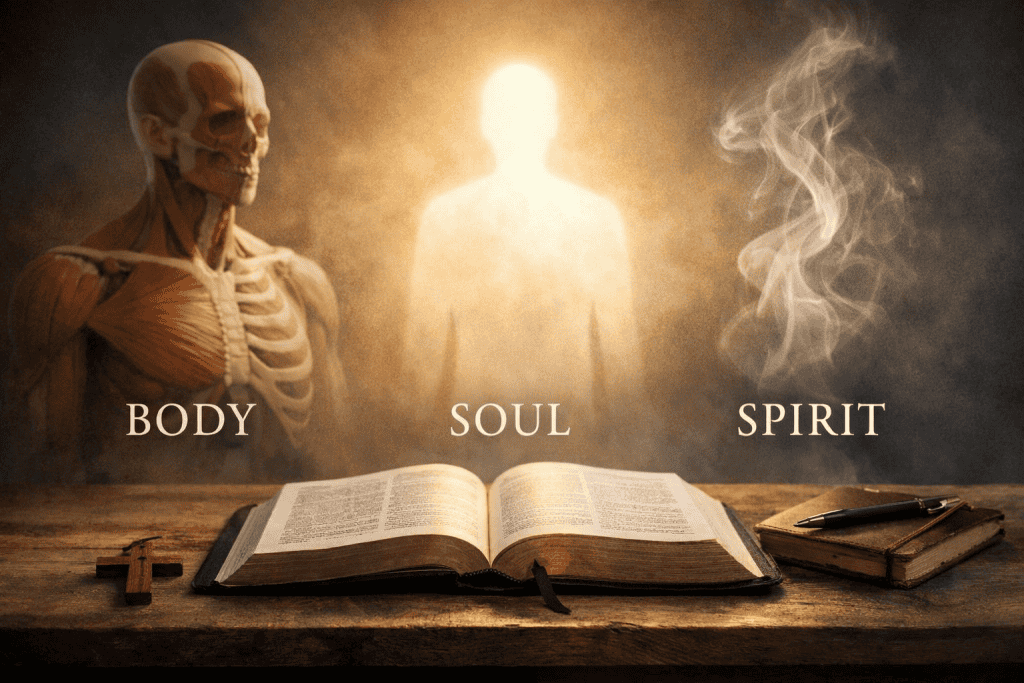
Some Christians conclude that Scripture presents human beings as made up of body and soul, where “soul” names the whole living person.
This reading leans heavily on Genesis 2:7. Man does not receive a soul. He becomes a living being. Nephesh refers to the living self, not a detachable part. In this framework, spirit refers to the life God gives and sustains, not to a separate component of human nature.
Texts like Ezekiel 18:4 (“the soul who sins will die”) reinforce this reading. So does the consistent biblical emphasis on resurrection as the solution to death, not the natural persistence of an inner essence.
Those who hold this view often say the Bible is less interested in describing human components and more interested in describing human dependence on God. Life continues only if God gives it.
The Body, Soul, and Spirit Reading
Other Christians conclude that Scripture points to a real distinction between soul and spirit.
They note that Jesus distinguishes soul and body in Matthew 10:28. They observe that Paul can speak of spirit, soul, and body together (1 Thessalonians 5:23). They point to passages where spirit is entrusted to God, strengthened, or distinguished from flesh in ways that seem to go beyond mere life-force.
In this framework, the soul often names personal identity, while spirit names orientation toward God. Resurrection remains essential, but conscious existence between death and resurrection is seen as real and personal.
Importantly, this view does not require the soul or spirit to be divine or self-sustaining. Life still depends on God. Immortality is still a gift, not a possession.
What Both Views Share
What matters for this article is not choosing between these models, but noticing what they share.
Both affirm:
- God as the giver of life
- Death as real and serious
- Judgment as comprehensive
- Resurrection as necessary
- Human dependence on God at every point
The disagreement is not over Scripture’s authority. It is over how Scripture’s language functions.
And that disagreement arises because Scripture speaks relationally and narratively before it speaks analytically.
Why the Early Church Spoke Carefully—and Why That Matters
When we turn to the early church, it’s tempting to look for decisive clarity. What we actually find is something more instructive: restraint.
The earliest Christians lived under persecution. Death was not abstract. Resurrection was not optional. It was central.
That context shaped how they spoke.
Writers like Irenaeus and Justin Martyr were explicit that immortality belongs to God alone. Life continues because God sustains it, not because the soul possesses it by nature.
Others, like Tertullian, spoke more confidently about continued existence, but even he did not collapse the Creator–creature distinction. The soul was created. It remained accountable. It was never divine.
By the time we reach Athanasius, the emphasis becomes even clearer. Immortality is something Christ restores. Resurrection is the goal. Salvation is not complete without it.
What is striking is not uniformity of explanation, but unity of posture. The early church guarded the center and allowed space at the edges. They refused to make resurrection unnecessary. They refused to make humans divine. And they refused to speak more clearly than Scripture did.
That posture is worth recovering.
How This Framework Shapes the Rest of the Conversation
Stepping back for a moment, it’s worth asking why any of this matters before we move on to the rest of the series.
The goal here is not to win a vocabulary debate. It is to read the Bible more carefully.
When we assume definitions Scripture never states, we load later passages with expectations they were never meant to carry. Judgment texts become proof texts. Resurrection becomes an add-on. Comfort passages are forced to explain metaphysics instead of offering hope.
But when we let Scripture set the categories, something shifts.
Judgment is no longer about what part of us survives. It is about standing before God as whole persons accountable to Him.
Resurrection is no longer symbolic or secondary. It becomes central again. Death is not quietly solved at the moment of dying. It is defeated because God raises the dead.
Eternal life is no longer framed as the escape of a soul from the body. It is life found in relation to Christ, secured by God, and completed in resurrection.
This also reshapes how we speak pastorally. Comfort does not rest on guessing what happens in the unseen. It rests on trusting the character and promises of God.
And it reshapes how we approach disagreement. If Scripture itself allows room for careful differences, then humility is not a weakness. It is obedience.
That is why this article had to come first.
Before asking what happens after death, we have to ask how the Bible talks about life at all.
Why Scripture Resists Neat Systematization
Scripture tells us what matters most. God gives life. Death is real. Judgment is real. Resurrection is necessary.
What it does not give us is diagrams.
That restraint keeps hope grounded in God, not in human constitution. Life is received, not possessed. If life continues beyond death, it does so because God sustains it.
Scripture leaves some questions open so we do not mistake our explanations for God’s promises.
Why Getting This Wrong Creates Real Confusion and Where This Leaves US
When confidence is built on anatomy instead of promise, assurance becomes fragile. People fear mechanics instead of trusting God.
- Scripture points us elsewhere. Hope rests in God’s faithfulness, not in what we are made of.
- Scripture leaves us with real distinctions, real warnings, real hope, and some unanswered questions.
- That is not a failure. It is a call to humility.
Before conclusions. Before systems. Scripture asks us to listen.
And that listening is where the rest of this series will continue.

Walt Roderick is a Christian writer who cares more about biblical clarity than online applause. He writes to strengthen believers and confront spiritual drift.