What Does the Bible Say About Free Will? The Answer Is More Uncomfortable Than You Think
What does the Bible say about free will? Most treatments of this question try to make everyone comfortable. They present both sides, acknowledge the tension, and land somewhere in the middle where nobody gets upset.
That’s not what the Bible does.
Scripture is not confused about this question. It does not present free will and God’s sovereignty as two equal truths that balance each other out and leave the answer open. It has a clear direction. And if you follow the text honestly — and follow the logic underneath the text — you end up somewhere most people weren’t expecting when they started.
That’s not a reason to avoid the question. It’s a reason to take it seriously.
Free Will Is Real — But That’s Not the Whole Question
Start here, because this is where most of the confusion begins.
The Bible does not deny free will. Human beings make real choices. Those choices are genuine, not an illusion. And Scripture holds people fully responsible for those choices from Genesis to Revelation. Nobody who takes the Bible seriously disputes that.
So the question is not whether free will exists. It does. The question is what a free will is actually free to do — and what has to happen before the will moves in any direction at all.
That second question is where the debate actually lives. And it’s where most treatments of free will never go.
The Thing That Has to Come Before the Choice
A.W. Pink, in his landmark work The Sovereignty of God, makes a point that cuts through most of this debate cleanly. His argument is this: free will choices are never made in a vacuum. Something always precedes the act of choosing. That something is desire.

No one ever chooses something they do not first desire. You may deliberate. You may weigh options. But when the will finally moves, it moves toward what the heart wants. Desire is the engine. The will is the wheel. The wheel only turns when the engine is running.
This is not a theological invention. It is simply how human beings work. Think of any decision you have made today — what you ate, what you read, what you avoided. Behind every one of those choices was a desire that preceded it. The choice expressed the desire. It did not create it.
This means that free will, properly understood, is always the freedom to choose what you desire. It is never the freedom to choose what you do not desire. No one freely chooses something their heart is not moving toward. That is not a choice — it is compulsion. And compulsion is the opposite of free will.
So the real question about free will and salvation is not whether man has the freedom to choose. It is whether the unregenerate heart has any desire for what salvation actually requires.
What the Unregenerate Heart Desires
The Bible is direct about the condition of the human heart outside of God’s regenerating work.
Jeremiah 17:9 — “The heart is deceitful above all things, and desperately sick; who can understand it?” This is not a description of a heart that leans toward sin but is capable of desiring God if it tries hard enough. It is a description of a heart that is fundamentally oriented away from God.
Romans 3:10-11 — “None is righteous, no, not one; no one understands; no one seeks for God.” The word seeks here is significant. It is not that unregenerate people fail to find God. It is that they do not seek him. The desire is absent. The will never moves toward God because the heart never wants him.
Ephesians 2:1-3 describes the unregenerate person as dead in trespasses and sins, following the course of this world, carrying out the desires of the body and the mind. Note what Paul says they are doing — carrying out desires. The will is active. It is freely choosing. But it is freely choosing exactly what the corrupt heart desires, which is everything except God.
This is the mechanism Pink identifies. The unregenerate man does not choose sin because he is forced to. He chooses it freely — because it is what he wants. His will is not constrained from the outside. It is bent from the inside. He is, as Jesus puts it in John 8:34, a slave to sin — not because someone is holding him captive, but because slavery to sin is the only freedom his heart knows how to exercise.
Why Salvation Is Never a Natural Desire
This is where the argument becomes most precise — and most uncomfortable.
Salvation is not simply a decision to improve your life or adopt a new belief system. It involves desiring holiness. It involves wanting accountability to God for how you have lived. It involves turning from the very things the unregenerate heart is most committed to — autonomy, self-determination, the right to define your own good.

These are not things the natural heart desires. They are, in fact, the opposite of what the natural heart desires. The unregenerate man does not want holiness. He does not want God sitting in judgment over his choices. He does not want to surrender control of his life to a sovereign who makes demands on him.
This is not because unregenerate people are uniquely monstrous. It is simply the condition of the human heart since the fall. As Pink argues, since desire must precede the will’s movement, and since the unregenerate heart is incapable of desiring the things salvation requires, the will never freely moves toward God. Not because it cannot do what it wants. Because it cannot want what God requires.
John 6:44 lands here with full force — “No one can come to me unless the Father who sent me draws him.” Jesus is not describing a difficult thing. He is describing an impossible thing given the state of the human heart. The inability is not external constraint. It is the internal absence of desire.
What Has to Change Before the Will Can Choose God
If desire precedes the will, and the unregenerate heart cannot desire God, then something has to change before salvation is possible. That something is the heart itself.
This is exactly what the Bible describes as regeneration — the new birth. Ezekiel 36:26 — “I will give you a new heart, and a new spirit I will put within you. And I will remove the heart of stone from your flesh and give you a heart of flesh.” God does not improve the old heart. He replaces it. And the new heart has new desires.
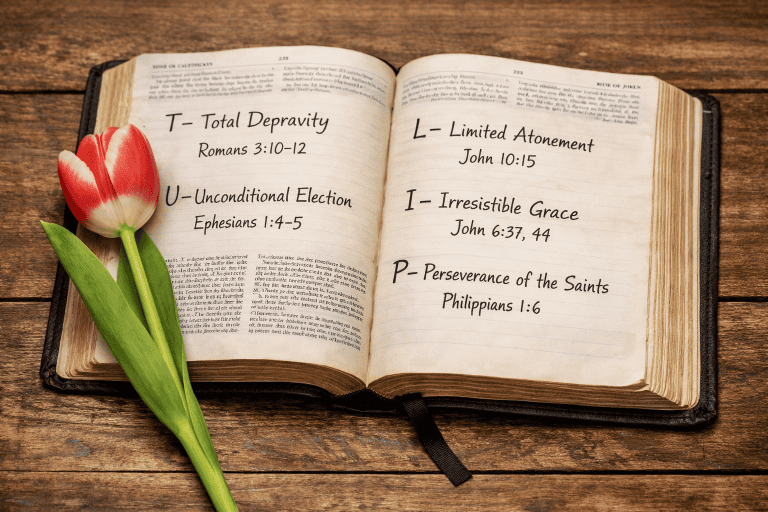
This is why the Reformed position insists that regeneration precedes faith — not as a theological technicality, but because of this logic. The new birth creates the capacity to desire God. That desire then moves the will. The will then chooses Christ. The choice is real. The faith is genuine. The responsibility is full. But none of it happens without God first changing what the heart is capable of wanting.
Ephesians 2:8-9 — “For by grace you have been saved through faith. And this is not your own doing; it is the gift of God.” The faith itself — the act of choosing — comes from God’s prior work. The will that chooses is a will God has already moved.
Where Human Responsibility Still Stands
None of this makes human choices an illusion or removes responsibility.
The person who rejects Christ does so freely — choosing exactly what his heart wants, which is a life without God’s authority over it. He is not forced to reject. He desires to. The responsibility is real.
The person who comes to Christ does so freely — choosing from genuine desire, genuine conviction, genuine faith. The choice is real. The responsibility is real. What the Bible adds is that the desire behind that choice was given, not generated. The heart that wanted God was a heart God had already changed.
Acts 2:23 holds both together without apology — the crucifixion was according to “the definite plan and foreknowledge of God,” and the men who carried it out were fully responsible for lawless murder. Fully planned. Fully responsible. The Bible does not resolve that tension by limiting one side. It holds both and moves on.
Why This Matters Beyond the Debate
This is not a seminary argument with no practical consequences.
If salvation ultimately depends on the natural human will making the right choice, then the gospel becomes a sales pitch. The evangelist’s job is to generate enough desire in someone who has none — to manufacture in the unregenerate heart something it cannot produce on its own. And assurance rests on whether your desire stays strong enough.
If salvation depends on God first giving a new heart with new desires — and that new heart then freely choosing Christ — then the gospel is a declaration, not a pitch. The evangelist proclaims what is true. God creates the desire. The will follows. And assurance rests not on the strength of your wanting, but on the faithfulness of the God who gave you the want in the first place.
John 10:28-29 — “I give them eternal life, and they will never perish, and no one will snatch them out of my hand. My Father, who has given them to me, is greater than all, and no one is able to snatch them out of the Father’s hand.”
The security is not in the grip of the believer. It is in the grip of the one who created the desire to believe.
Keep Reading in This Series

Walt Roderick is a Christian writer who cares more about biblical clarity than online applause. He writes to strengthen believers and confront spiritual drift.