Why Christians Read Judgment Texts Differently
Scope and Purpose of This Article
This article is not an argument for annihilationism or eternal conscious torment. I’m not going to walk through individual judgment passages here, and I’m not going to revisit the biblical meaning of words like death, destruction, or perishing. Those questions are already handled elsewhere in this series.
What I want to do here is simpler.
If you’ve ever wondered how Christians who share a high view of Scripture can read the same judgment passages and still come away with very different conclusions, the answer usually isn’t found in the verses themselves. It’s found earlier than that. Long before anyone opens a Bible to a particular passage, certain assumptions are already in place—often without being noticed—about the soul, about justice, about resurrection, and about what eternal punishment must mean.
This article brings those assumptions into the open. Not to settle the debate, but to explain why the debate works the way it does. Until those starting points are named, Christians will keep talking past one another—not because the texts are unclear, but because they are being read from different places.

Disagreement Begins Before Interpretation
When Christians disagree about final judgment, the disagreement is usually framed as a disagreement over verses. One side points to certain passages. The other side responds with different ones. The assumption is that if the texts were just read carefully enough, the issue would sort itself out.
But interpretation never starts with a blank page.
By the time someone arrives at a judgment text, certain ideas are already in their head—ideas about what a human being is, what punishment must involve, and what it would mean for God to judge justly. Those ideas usually aren’t the result of a close reading of the passage in front of them. More often, they’ve been picked up over time through teaching, tradition, and repetition.
That’s why two Christians, both committed to the authority of Scripture, can read the same verse and hear something very different. The difference isn’t always in the text itself. It’s in what the reader expects the text to be saying. One reader assumes punishment must be consciously experienced to be meaningful. Another doesn’t. One assumes the soul exists forever by nature. Another assumes immortality is something God gives, not something humans automatically have.
None of those assumptions are stated out loud when a verse is quoted. But they quietly shape how the verse is heard. Until they’re recognized, debates over judgment texts tend to go in circles. Verses get traded back and forth, positions harden, and very little clarity is gained.
Before asking what a particular passage says, it’s worth asking a more basic question: what is already being assumed when that passage is read?
Immortality as an Assumption, Not a Conclusion
One of the most important assumptions readers bring to judgment texts has to do with whether the human soul is thought to be naturally immortal. For many Christians, this idea feels so familiar that it hardly feels like an assumption at all. The soul simply continues. Judgment, then, is about the condition of that existence, not whether it continues in the first place.
When that starting point is in place, certain conclusions follow almost automatically. Punishment must be ongoing, because there is an ongoing subject to receive it. Destruction cannot mean the end of existence, because existence itself is assumed to be indestructible. Language about death or perishing is therefore heard as metaphorical rather than final.
Other Christians come to the same texts with a different expectation. They do not assume that human beings possess immortality by nature. Instead, immortality is understood as something God grants, especially in connection with resurrection and eternal life. From this perspective, judgment does not presuppose an endlessly existing soul. It presupposes accountability before God, with life or death as real outcomes.
Most people have never stopped to ask whether continued existence is actually what’s at stake in judgment. That question is often answered before the text is ever read. As a result, the same passage about punishment or destruction can sound very different depending on whether immortality is treated as a given or as a gift.
This is one reason debates over final judgment stall so easily. Both sides appeal to Scripture, but they’re not starting from the same place. Until that difference is acknowledged, disagreements over judgment language tend to circle without getting anywhere.
Justice and the Shape of Judgment
Another assumption that quietly shapes how judgment texts are read has to do with what justice is thought to require. Most readers bring an instinctive sense of fairness to the Bible long before they begin interpreting it. That instinct then influences how language about punishment is heard.
Justice as Ongoing Punishment
For some readers, justice is assumed to require ongoing punishment. If sin is committed against an eternal God, the reasoning goes, then the penalty must also be eternal in duration. Judgment, in this view, is less a decisive act and more a condition that continues without end.
When this assumption is in place, passages that speak of eternal punishment are naturally heard as describing an unending experience. A punishment that comes to an end can feel incomplete, as though justice itself has been cut short. Even severe judgment may seem insufficient if it does not continue.
Justice as Final and Proportionate Judgment
Others approach justice differently. Here, justice is understood in terms of finality and proportion. Judgment is something God carries out fully and rightly, not something that must be continually administered. Once judgment has been rendered, it reaches its end.
In this framework, the seriousness of punishment is measured by its outcome, not by how long it lasts. A judgment can be final, irreversible, and fully just without requiring endless experience. A punishment that ends does not signal leniency. It signals completion.
These instincts shape interpretation in quiet but important ways. A punishment that ends may seem insufficient to one reader, while an unending punishment may seem excessive or incompatible with justice to another. What often feels like a disagreement over verses is just as often a difference in what justice is already assumed to look like.
Again, the point here isn’t to decide which view of justice is right. It’s to recognize that these assumptions are already at work when judgment texts are read. Until they’re named, discussions about final punishment tend to drift away from careful reading and toward arguments about fairness instead.
Resurrection and the Logic of Judgment
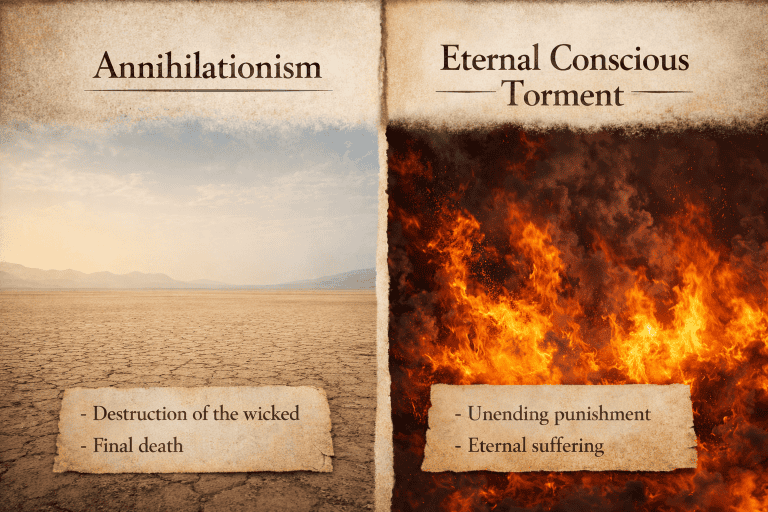
Both annihilationism and eternal conscious torment affirm the resurrection of the dead. That part isn’t disputed. The difference lies in what resurrection is understood to do in relation to judgment.
In many explanations of eternal conscious torment, resurrection is assumed for both the righteous and the wicked, but continued existence is never really in question. The soul is already assumed to endure. Resurrection restores the body, and judgment determines the condition under which that ongoing existence will continue. Resurrection prepares a person for judgment, but it doesn’t decide whether life itself will persist.
Annihilationism approaches resurrection from a different angle. Here, resurrection isn’t simply the restoration of someone already assumed to exist forever. It’s the act by which God brings the dead to judgment at all. Judgment then determines the outcome of that resurrection—either the granting of eternal life or the final loss of life. In this view, resurrection places continued existence itself on the line.
That difference quietly shapes how judgment texts are heard. Passages that speak about resurrection, life, and judgment will sound different depending on whether resurrection is seen as restoring an already immortal subject or as the moment when God determines whether life continues or ends.
Once again, the disagreement doesn’t start with the text. It starts with how resurrection is already being imagined. Until that difference is made clear, Christians can affirm the same Scriptures and still walk away with very different conclusions.
Why “Eternal” Carries Different Weight
Few words create more disagreement in discussions of final judgment than the word eternal. It looks simple, but it often carries more meaning than readers realize. As with everything else in this discussion, the disagreement doesn’t begin with the word itself, but with what people already expect the word to mean.
For some, eternal is heard almost automatically in terms of duration. If something is eternal, it must continue without end. Applied to punishment, that instinctively suggests an ongoing state of conscious experience that never concludes. Under that assumption, a punishment that ends—no matter how severe—doesn’t seem to fit.
Others hear eternal differently. Rather than listening first for duration, they listen for outcome. Eternal punishment, in this view, is punishment whose effect is final and irreversible. The emphasis falls on what the punishment accomplishes, not on how long the process lasts. A judgment can be eternal in consequence without requiring endless experience.
That difference explains why the same phrases are heard so differently. One reader listens for continuity. Another listens for finality. Both are responding to the same word, but they’re hearing it through assumptions already in place about immortality, justice, and resurrection.
By this point, it should be clear why debates over final judgment so often remain stuck. When readers assign different weight to the same terms before interpretation even begins, quoting more verses rarely brings clarity. The disagreement isn’t only about what the texts say, but about what readers already expect them to mean.
Only once those assumptions are brought into the open can the texts themselves be examined with care. The next step isn’t to argue for a conclusion, but to look closely at how the key judgment passages are read within these different ways of thinking.
Clearing the Ground Before the Texts

This article hasn’t tried to settle the question of final judgment. It’s done something more basic. It’s shown that disagreement over judgment texts doesn’t begin with the texts themselves, but with assumptions readers bring to them—often without realizing it.
Recognizing those starting points doesn’t resolve the debate, but it does make it more honest. When assumptions stay hidden, discussions tend to collapse into verse-trading or arguments about fairness. When they’re named, the shape of the disagreement becomes clearer, and the texts themselves can be approached more carefully.
With this groundwork in place, it becomes possible to look directly at the judgment passages most often cited in this debate—not to force a verdict, but to see how they function within these different interpretive starting points. That’s the task of the next article.

Walt Roderick is a Christian writer who cares more about biblical clarity than online applause. He writes to strengthen believers and confront spiritual drift.