TULIP Calvinism: What the Five Points Mean and Why They Matter
TULIP Calvinism is one of the most misunderstood frameworks in all of Christian theology. People who reject it often reject a caricature. People who embrace it sometimes can’t explain what it actually means or where it came from.
Most people assume TULIP is simply “Calvinism” — the theological system of John Calvin. That’s not quite right. TULIP was not written by Calvin. It was written in response to people who attacked Reformed theology after Calvin was already dead. Understanding that history changes how you read the five points entirely.
Where TULIP Calvinism Actually Came From
In the early 1600s, a Dutch theologian named Jacobus Arminius began challenging the Reformed doctrine of predestination and God’s sovereignty that had come out of the Reformation. He wasn’t trying to return to Rome. He was arguing from within the Reformed tradition that the standard teaching on election, grace, and salvation gave too much to God and not enough to human choice.
After Arminius died, his followers — called the Remonstrants — formalized his objections into five points and presented them to the Dutch Reformed Church. Their five positions were: conditional election, universal atonement, cooperative ability, resistible grace, and the necessity of perseverance as a condition of salvation. In short: God elects based on foreseen faith, Christ died for everyone, man cooperates with grace, grace can be resisted, and you can lose your salvation.
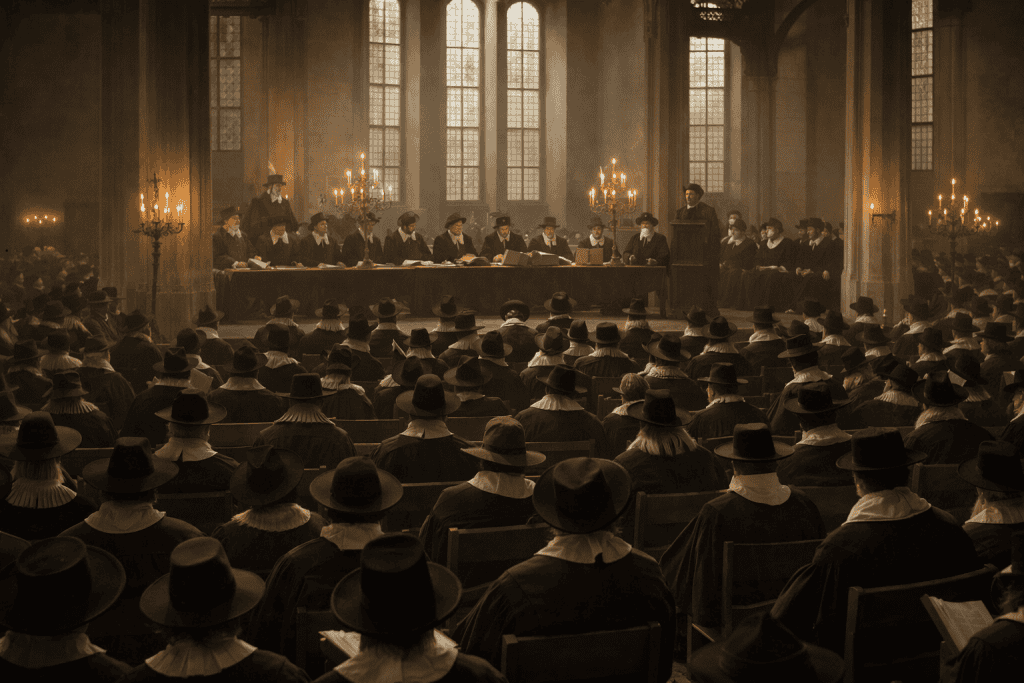
In 1618, the Synod of Dort — a gathering of Reformed leaders from across Europe — convened to evaluate these five Remonstrant positions against Scripture. Their response to each of the five Arminian points became the five points of Calvinism. TULIP is not an unprovoked system. It is a point-by-point biblical answer to five specific theological challenges.
That matters because it means the five points of TULIP are not arbitrary distinctives of Calvinist theology. They are the places where Reformed theology and Arminian theology most directly disagree — and where the Bible, examined honestly, decides the question.
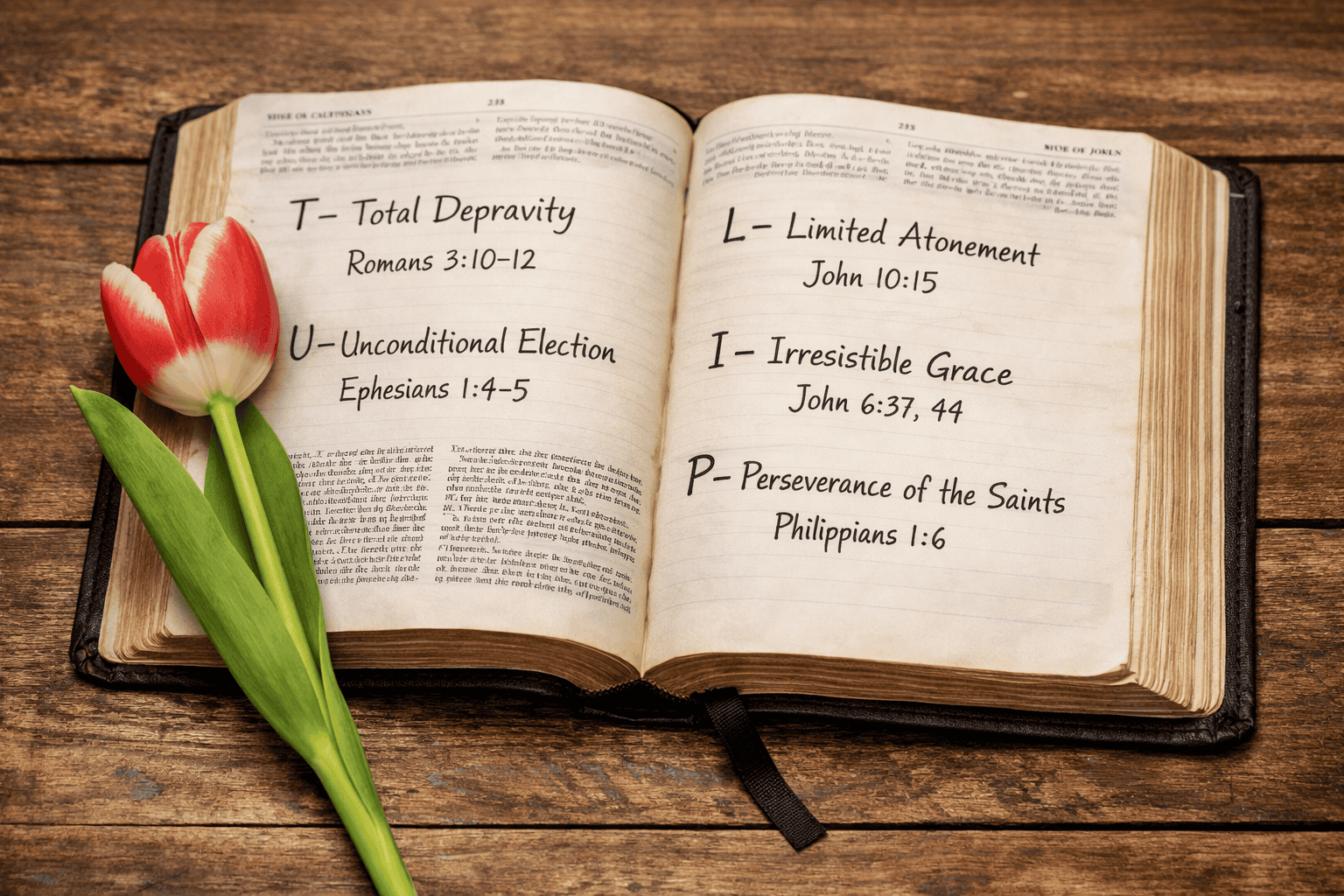
T — Total Depravity
Total depravity is the most misunderstood of the five points because the name sounds like it means something it doesn’t.
Total depravity does not mean that every human being is as wicked as they could possibly be. Some use the term ‘utter depravity’ to describe man as hopelessly and irredeemably evil in every action — that is not what total depravity teaches. It does not mean that unregenerate people are incapable of kindness, love, or moral behavior toward each other.
The key word is total. Not maximum, but pervasive. Sin has gone all the way through.
The biblical foundation is straightforward. Romans 3:10-11 — “None is righteous, no, not one; no one understands; no one seeks for God.” Ephesians 2:1 describes the unregenerate as “dead in trespasses and sins.” Dead is not a description of someone weakened or impaired. Dead means no capacity for spiritual response without God first acting.
As the previous posts in this series have established, the mechanism is desire. The unregenerate heart is not capable of desiring what salvation requires — holiness, accountability to God, surrender of self-determination. The will is free, but it only moves toward what the heart wants. And the unregenerate heart does not want God.
Total depravity is the T that makes the rest of TULIP necessary. If man could reach God on his own, unconditional election would be unnecessary. If grace could be earned or cooperated with by the natural will, irresistible grace would be unnecessary. The entire structure of the remaining four points rests on this one.
U — Unconditional Election
The Arminian position on election is that God looks down the corridor of time, foresees who will freely choose him, and elects them on that basis. Election, in this view, is conditional — conditioned on the foreseen human choice.
The Reformed position is that election is unconditional. God does not elect based on foreseen faith or foreseen merit. He elects according to his own sovereign will and purpose, apart from anything in the creature.
Ephesians 1:4-5 — “He chose us in him before the foundation of the world… having predestined us for adoption to himself as sons through Jesus Christ, according to the purpose of his will.” Before the foundation of the world. Not based on what he saw us doing. Based on his own will.
Romans 9:11 makes the logic explicit in the case of Jacob and Esau — chosen before birth, before either had done anything good or bad, “so that God’s purpose of election might continue, not because of works but because of him who calls.” Paul goes out of his way to eliminate the foreseen-merit interpretation. The basis is God’s calling, not human action.
The common objection is that unconditional election makes God arbitrary or unjust. Paul anticipates this in Romans 9:14 — “Is there injustice on God’s part? By no means!” His answer is that mercy is never owed. God is not obligated to save anyone. That he saves any is grace. That the basis of his choice is his own will rather than human merit does not make him unjust — it makes salvation entirely a matter of grace.
L — Limited Atonement
Limited atonement is the most contested of the five points — even among those who hold the other four. Some hold to four-point Calvinism, accepting TUIP but rejecting the L.
The question is this: did Christ die to make salvation possible for everyone, or did he die to actually secure salvation for the elect?

The Arminian position is that Christ’s atonement is universal in scope — he died for every person who ever lived, making salvation available to all. Whether any individual benefits depends on their choice to accept it.
The Reformed position is that Christ’s atonement is particular in its design — he died to actually accomplish redemption for those the Father had given him, not merely to make it theoretically available to everyone.
John 10:11 — “I am the good shepherd. The good shepherd lays down his life for the sheep.” Not for everyone who might possibly become a sheep. For the sheep. John 10:15 — “I lay down my life for the sheep.” John 17:9 — Jesus prays for his disciples and says explicitly, “I am not praying for the world but for those whom you have given me.”
The passages cited for universal atonement — John 3:16, 1 Timothy 2:6, 2 Peter 3:9 — do not require unlimited atonement when read carefully. “World” in John’s usage often means people from all nations and peoples, not every individual without exception. “All” in 1 Timothy and 2 Peter fits the same pattern.
The practical argument for particular atonement is this: if Christ’s death was designed to save everyone but actually saves only those who choose to accept it, then what Christ accomplished on the cross was potential salvation, not actual salvation. The Reformed position insists that what Christ accomplished was definite — he secured the redemption of those the Father gave him, and not one of them will be lost.
I — Irresistible Grace
Irresistible grace does not mean that God forces people to be saved against their will. It means that when God sovereignly works to bring one of his elect to salvation, that work is effective. It accomplishes what it intends.
The Arminian position is that grace can be resisted — that a person can hear the gospel, feel the conviction of the Spirit, and ultimately reject it, with that rejection being final and God being unable to overcome it.
The Reformed position is that God’s effectual calling — his sovereign work in the heart of the elect — always succeeds. It does not override the will. It transforms the will. It gives the person a new heart with new desires, so that they come to Christ freely and willingly — because they now want to.
Ezekiel 36:26-27 — “I will give you a new heart, and a new spirit I will put within you. And I will remove the heart of stone from your flesh and give you a heart of flesh. And I will put my Spirit within you, and cause you to walk in my statutes.” Notice the language. God does not invite. He gives. He removes. He puts. He causes. This is not a description of God making salvation available and waiting to see if the person accepts it. It is a description of God acting decisively to transform the person.
John 6:37 — “All that the Father gives me will come to me.” Not some. Not most. All. The ones the Father has given to the Son will come. The effectual call does not fail.
This does not make the person passive. The new heart freely and genuinely chooses Christ — because it now desires him. The choice is real. The faith is genuine. But the capacity to make that choice was given, not generated.
P — Perseverance of the Saints
Perseverance of the saints is often confused with the popular phrase “once saved, always saved” — and while the conclusions are similar, the reasoning is different and matters.
“Once saved, always saved” can imply that a one-time decision guarantees eternal security regardless of what follows. Perseverance of the saints means something more specific: those whom God has truly regenerated will persevere in faith to the end — not because they are strong enough to hold on, but because God holds onto them.
The Arminian position — the one the Synod of Dort was responding to — is that salvation can be lost. A genuinely saved person can fall away and forfeit their salvation through persistent sin or unbelief.
The Reformed position is that genuine salvation cannot be lost, because it does not ultimately rest on the human will sustaining itself but on God’s electing purpose completing what it began.
Philippians 1:6 — “He who began a good work in you will bring it to completion at the day of Jesus Christ.” He began it. He completes it. John 10:28-29 — “I give them eternal life, and they will never perish, and no one will snatch them out of my hand. My Father, who has given them to me, is greater than all, and no one is able to snatch them out of the Father’s hand.”
The security is not in the believer’s grip on God. It is in God’s grip on the believer.
This does not mean that someone can pray a prayer, live however they want, and assume they are eternally secure. Perseverance of the saints means that genuine regeneration produces genuine and lasting fruit. Someone whose life shows no evidence of transformation has reason to question whether the regenerating work of God ever occurred — not because they lost their salvation, but because the evidence suggests they may never have had it.
TULIP as a System
The five points hold together as a system. Remove one and the others are affected.
If total depravity is denied — if man retains the natural ability to seek God — then unconditional election becomes unnecessary. God can simply elect those he foresees choosing him.
If unconditional election is denied — if election is based on foreseen faith — then the atonement need not be particular. Christ can die for everyone since anyone might choose him.
If particular atonement is denied — if Christ died to make salvation available to all — then irresistible grace becomes less critical. The Spirit only needs to make the offer, not secure the result.
If irresistible grace is denied — if the human will can ultimately resist God’s saving work — then perseverance becomes uncertain. What the human will accepted, the human will might later reject.
The Arminian system is equally coherent in the other direction. The five Remonstrant points hold together just as the five Reformed points do. This is why the debate has persisted for four centuries. It is not a debate between people who read the Bible and people who don’t. It is a debate about which texts are controlling and which direction the whole system runs.
The Reformed position, examined honestly, follows the logic of total depravity all the way through to its conclusions. If man is dead in sin and cannot desire God, then everything else — election, atonement, grace, perseverance — must be God’s work from beginning to end.
That is what TULIP teaches. And that is why it matters.
Keep Reading in This Series
- What Does the Bible Say About Free Will?
- Free Will vs Predestination: What the Bible Actually Teaches
- Does God’s Election Cancel Free Will?

Walt Roderick is a Christian writer who cares more about biblical clarity than online applause. He writes to strengthen believers and confront spiritual drift.