Annihilationism and Conditional Immortality: A Historical and Theological Overview
A Note on How This Article Was Written
This article was written with the assistance of ChatGPT 5.2, used as a tool to help gather sources, trace historical threads, and organize material across long stretches of church history. The judgments about what to include, how to frame it, and what conclusions to avoid are my own.
I am not writing this to take a side or to press an outcome. After years of reading Scripture carefully and watching sincere Christians argue over this issue without ever agreeing on what they were actually disagreeing about, I learned to slow down before drawing lines.
My aim here is simpler. I want to show how this controversy came to exist, how its language developed, and why it cannot be treated as a clean, black-and-white disagreement that has always been settled. Before anyone argues about conclusions, it is worth seeing how the questions were first asked, and what assumptions were quietly brought along the way.
This piece is meant to slow the conversation down. To clear the ground. To let the history speak before the verdicts are reached.
————————————————————————–

Read this as a historical map, not a verdict.
Before tracing history or weighing theological outcomes, the discussion must be anchored in clear definitions. Modern discussions often address annihilationism and conditional immortality together, even though they are historically and conceptually distinct (Evangelical Dictionary of Theology, s.v. “Conditional Immortality” and “Annihilationism”). Historically and conceptually, they are not the same thing.
What Is Conditional Immortality?
Conditional immortality begins with a claim about human nature rather than a detailed theory of final punishment. It holds that human beings are not immortal by nature (Edward W. Fudge, The Fire That Consumes, rev. ed.).
Immortality is not an inherent property of the soul but a gift granted by God, typically understood to be received through resurrection and union with Christ (1 Tim 6:16; Rom 2:7; 1 Cor 15:42–54; Justin Martyr, Dialogue with Trypho 5; Irenaeus, Against Heresies 2.34–38).
Under conditional immortality, continued existence itself is contingent. Life persists because God sustains it. Apart from that sustaining will, human beings do not possess an indestructible essence that guarantees endless existence. Immortality, therefore, is conditional rather than automatic.
This framework places emphasis on:
- God as the sole source of immortality
- Human dependence rather than self-sustaining existence
- Resurrection as the means by which immortality is conferred
Historically, conditional immortality appears in early Christian writers who reject the assumption that the soul is naturally immortal. The position does not, by itself, require a specific model of final punishment. It establishes a premise about what humans are, not yet a conclusion about what judgment entails.
What Is Annihilationism?
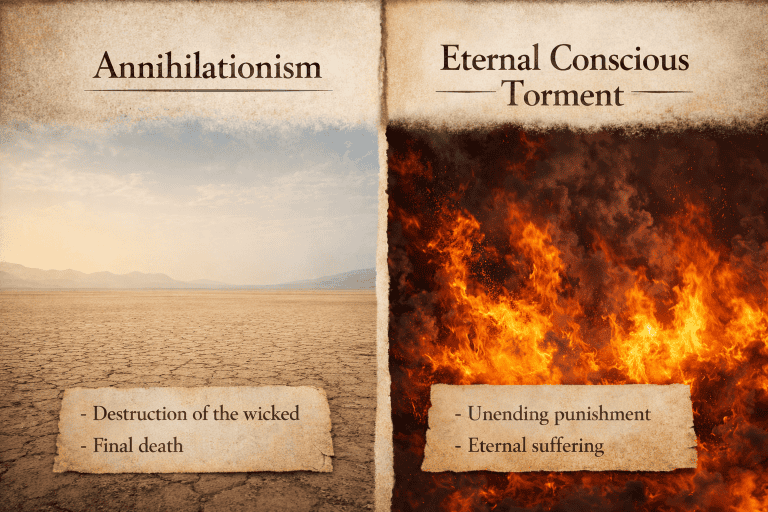
Annihilationism is an eschatological claim focused on outcome rather than ontology. It holds that the wicked will ultimately be destroyed, cease to exist, or be brought to an irreversible end rather than experiencing endless conscious punishment (Oxford Dictionary of the Christian Church, s.v. “Annihilationism”).
Unlike conditional immortality, annihilationism does not begin with a theory of the soul. It describes what happens at the final judgment. In many theological systems, annihilationism follows naturally from conditional immortality. If humans are not inherently immortal, and if immortality is granted only to the redeemed, then the final destruction of the unredeemed becomes a coherent possibility.
However, the two positions are not identical:
- Conditional immortality addresses the nature of human existence
- Annihilationism addresses the fate of the wicked
Historically, this conclusion sometimes appears as the result of conditional premises rather than as a standalone doctrine (Arnobius of Sicca, Adversus Nationes [Against the Nations] II.64–68; cf. Edward Fudge, The Fire That Consumes, rev. ed., esp. chs. 1–3).
Why the Two Are Commonly Confused
The frequent conflation of these two positions is largely a modern phenomenon. The confusion arises for several reasons.
First, annihilation is a logical outcome of conditional immortality in many theological systems, which leads readers to treat the premise and the conclusion as the same doctrine. Second, later theological debates tended to label entire positions by their most controversial endpoint rather than by their underlying assumptions. Third, modern summaries often prioritize brevity over conceptual accuracy, collapsing distinct ideas into a single term for convenience.
Historically, this collapse obscures important distinctions. Early Christian writers often denied natural immortality without fully systematizing a doctrine of final punishment. In those cases, conditional immortality was present even when annihilation was only implied rather than explicitly stated.
Maintaining this distinction is essential for historical clarity. Without it, early sources are misclassified, and later developments are read backward into periods where the categories did not yet exist.
Biblical Anthropology: Hebrew and Greek Frameworks
The disagreement that later becomes associated with these views does not begin with descriptions of hell. It begins with competing understandings of what it means to be human. Anthropology, not eschatology, is the controlling factor.
Two broad frameworks shape the development of Christian thought on life, death, and judgment: a Hebraic framework rooted in Scripture and a Greek philosophical framework inherited from the surrounding culture.
The Hebraic View of Life and Death
In the Hebrew Scriptures, life is consistently portrayed as something received, sustained by God’s breath and will (e.g., Genesis 2:7; Psalm 104:29–30; Ezekiel 37).
Human beings do not possess life inherently. They live because God gives life, and they die when that life is withdrawn.
Within this framework:
- Death has a dominant emphasis in the Hebrew Bible as the loss of life, rather than the continuation of life in another conscious mode (e.g., John Cooper, Body, Soul, and Life Everlasting).
- Immortality belongs properly to God alone (1 Timothy 6:16).
- Resurrection is necessary precisely because death is real and final apart from divine intervention.
This understanding carries into the New Testament, where eternal life is presented as a gift, not an assumption. Resurrection is not redundant. It is required because humans are mortal and do not naturally survive death in an immortal state.
This anthropological backdrop aligns naturally with conditional immortality. If life depends on God, then continued existence after judgment is not guaranteed apart from God’s sustaining purpose.
The Greek Philosophical View of the Soul
In contrast, Greek philosophical traditions, particularly those influenced by Platonism, approach human nature dualistically (Plato (Phaedo, Republic)). The soul is understood as an immortal substance temporarily housed in the body. Death, in this view, is not the loss of life but the release of the soul from physical constraints.
Under this framework:
- Immortality is intrinsic rather than granted
- Death is redefined as separation rather than cessation
- The soul necessarily continues to exist, regardless of divine judgment
When this assumption is applied within Christian theology, it reshapes how judgment is understood (Alan Bernstein, The Formation of Hell). If all souls are immortal by nature, then final punishment cannot involve the loss of existence. It must instead take the form of unending conscious experience.
Why This Shift Matters for the Debate
The divergence between conditional immortality and eternal conscious torment is often presented as a disagreement over specific biblical texts. Historically, however, it is more accurately described as a disagreement over anthropological starting points.
Once the immortality of the soul is assumed, annihilation becomes incoherent by definition. Once immortality is treated as conditional, annihilation becomes at least conceptually possible. Scripture is then interpreted through these prior commitments, often without those commitments being stated explicitly.
This is why early Christian writers can sound ambiguous to modern readers. They are often operating within a Hebraic framework without feeling the need to defend it against a fully developed immortal-soul anthropology. As Greek metaphysical assumptions gain influence, the terms of the debate change, and conclusions harden accordingly.
Understanding this shift is essential for reading the historical development of the doctrine accurately. Without it, later outcomes are mistaken for early consensus, and anthropology is mistaken for exegesis.
The Apostolic Era (1st Century): The Question Is Implicit
In the New Testament period, the debate later framed in these terms does not yet exist as a defined controversy. There are no formal camps, no later metaphysical system, and no systematic treatments of the soul’s nature. What exists instead are the raw conceptual materials from which later positions will be constructed (N. T. Wright, The Resurrection of the Son of God; cf. Paul and the Faithfulness of God).
The apostolic writings consistently speak of life, death, resurrection, and judgment, but they do so without philosophical speculation about innate immortality. Immortality is consistently presented as something received through resurrection rather than explicitly defined as an innate human property (Romans 2:7; 1 Corinthians 15).
Language of Death, Destruction, and Life
The New Testament uses a range of terms to describe judgment and its consequences, including death, perishing, destruction, and the second death. These terms are not defined philosophically, but they are presented as meaningful realities rather than metaphors for an alternate form of life.
At the same time, eternal life is framed as a gift associated with resurrection and union with Christ. Life is something entered into, received, and sustained by God. This framing would make little sense if human beings were already immortal by nature.
The resurrection occupies a central place in apostolic teaching precisely because death is treated as a genuine loss of life. Resurrection restores life. It does not merely reunite a body with an already immortal soul.
What Is Not Yet Defined
It is important to note what the apostolic era does not provide.
There is no explicit doctrine of the soul’s natural immortality. There is no systematic explanation of post-mortem consciousness apart from resurrection. There is also no formal articulation of annihilation as a defined outcome. These later developments arise only when Christians begin asking philosophical questions the apostolic texts themselves do not address directly.
Because of this, modern readers often misread the New Testament by importing later categories into an earlier period. The apostolic writings establish dependence on God for life, but they do not yet press that premise toward a fully articulated eschatological model. The question of immortality is present, but it remains implicit rather than systematized.
Late 1st–2nd Century: Conditionality Becomes Explicit
By the late first and second centuries, Christian writers begin addressing questions about human nature more directly. This is not driven by idle speculation, but by engagement with competing philosophies, internal theological disputes, and challenges from surrounding cultures that assumed the soul’s natural immortality.
In this period, the implicit assumptions of the apostolic era begin to take explicit form.
Early Christian Voices on Life and Immortality
Several early Christian writers clearly deny that humans possess immortality by nature. Instead, they present continued life as something dependent on God’s will and sustaining power.
Ignatius of Antioch, writing in the early second century, consistently frames life as something bound up with relationship to God. In Epistle to the Ephesians 20.2, he refers to Christ as the “medicine of immortality,” framing life and immortality as participation in Christ rather than as an inherent human property.
Justin Martyr goes further by explicitly rejecting the Platonic doctrine of the soul’s natural immortality, arguing in Dialogue with Trypho that souls live only insofar as God wills them to live rather than by any inherent indestructibility (Justin Martyr, Dialogue with Trypho 5).
Irenaeus of Lyons offers one of the clearest early articulations of conditionality. In opposing Gnostic thought, Irenaeus insists that humans are created, dependent beings. Immortality is not a built-in property of the soul but something granted by God (Irenaeus of Lyons, Against Heresies 2.34; 5.27). Continued existence itself is conditional upon God’s sustaining purpose.
These writers do not present a unified eschatological system. They do not speculate extensively about the mechanics of final punishment. What they do share is a rejection of natural immortality and an insistence that life, in every sense, depends on God.
Conditional Immortality Without the Label
At this stage, conditional immortality exists as a coherent theological position, even though the term itself will not appear for many centuries. The core claims are already present:
- Humans are not immortal by nature
- God alone is the source of life
- Immortality is granted, not assumed
What is still developing is how these premises are carried forward into doctrines of final judgment. Some writers remain content to affirm conditionality without pressing the question of ultimate outcomes. Others will begin to draw more explicit conclusions in the following centuries.
This period is significant because it demonstrates that conditional immortality is not a modern revision or a reaction to later moral sensibilities. It emerges naturally as early Christians clarify their anthropology in contrast to prevailing philosophical assumptions.
The groundwork is now laid for the next development: a divergence driven not primarily by Scripture, but by competing metaphysical frameworks.
The 2nd–3rd Century Fork: Competing Anthropologies
By the late second and early third centuries, the discussion surrounding life, death, and judgment begins to change shape. The shift does not occur because new biblical texts are discovered, but because Christian thinkers increasingly engage with philosophical frameworks that carry their own assumptions about human nature.
At this point, the Christian tradition encounters a fork in the road. Two competing anthropologies begin to operate side by side, often without being explicitly acknowledged as alternatives.
Scriptural Language and Philosophical Assumptions
The biblical language inherited from the apostolic period continues to speak of death as death and life as something given by God. However, as Christianity spreads through the Greco-Roman world, it does so within a cultural environment that largely assumes the soul’s natural immortality.
Greek philosophical traditions, especially those influenced by Platonism, approach the question of human existence from a different starting point. The soul is understood as an immortal substance, and death is interpreted as a transition rather than a termination of life. When these assumptions are brought into Christian theology, they subtly reshape how biblical terms are read.
Words such as death, destruction, and perishing are no longer allowed to carry their ordinary sense. Instead, they are reinterpreted to mean separation, loss of well-being, or altered relational status. The language of Scripture remains the same, but the conceptual framework behind it has shifted.
This development marks a significant turning point. The disagreement is no longer simply about how to describe judgment, but about how to understand the basic nature of human existence.
A Clear Early Example of the Conditional Logic
One of the clearest illustrations of this period is found in the writings of Arnobius of Sicca, writing in the late third century. Arnobius explicitly rejects the idea that the soul is immortal by nature. For him, souls are created and sustained by God, and they do not possess inherent indestructibility.
From this premise, Arnobius draws a conclusion about judgment that later writers will give a formal label. Because the soul is not immortal by nature and continues only by God’s sustaining will, the wicked, lacking inherent immortality and not granted continued life by God, ultimately come to an end (Arnobius of Sicca, Against the Heathen 2.14–16).
Importantly, Arnobius does not present this as a speculative innovation. It is treated as the logical outcome of a conditional anthropology.
Arnobius’s significance lies not in system-building but in clarity. He demonstrates how different anthropological assumptions lead to different eschatological conclusions, even when Scripture remains the shared authority. The fork in the road is now visible.
The 4th–5th Century Consolidation: Eternal Conscious Torment Dominates
By the fourth and fifth centuries, one of the competing anthropological frameworks begins to solidify into a dominant position within Western Christianity. This consolidation is not the result of a single argument or council, but of a broader theological synthesis that brings together Scripture, philosophy, and ecclesial authority.
The Role of Augustine of Hippo
Augustine of Hippo plays a central role in this process. In The City of God, he offers a sustained defense of eternal punishment that later becomes foundational for Western Christian accounts of final judgment (Augustine, City of God XXI).
Augustine inherits a Christian tradition already engaged with Greek philosophical concepts, including the assumption that the soul is immortal by nature. Rather than questioning this premise, he incorporates it into a comprehensive theological system.
Within this framework, eternal conscious torment becomes the natural conclusion. If the soul cannot cease to exist, then final punishment must involve ongoing conscious experience. Augustine acknowledges that biblical language could be read in different ways, but he consistently interprets that language through the lens of immortal-soul anthropology.
Augustine’s influence is difficult to overstate. His writings shape Western theology for centuries, and his assumptions about the soul become so deeply embedded that they are rarely examined explicitly in later debates.
What Dominance Means and Does Not Mean
The rise of eternal conscious torment as the dominant view does not indicate that alternative positions were unknown or refuted decisively. It indicates that a particular anthropological framework achieved institutional and theological prominence.
From this point forward:
- The immortality of the soul comes to be widely treated as settled doctrine within Western Latin theology, particularly following the influence of Augustine of Hippo. This assumption, however, is not emphasized uniformly across all Christian traditions and is less pronounced in Eastern Christianity.
- Eternal conscious torment becomes the default understanding of final punishment
- Conditional immortality recedes from mainstream theological discourse
This dominance narrows the range of acceptable interpretations without eliminating earlier perspectives. Theological development continues, but within boundaries largely set by Augustinian assumptions.
Understanding this consolidation is essential for historical clarity. It explains why later readers often assume eternal conscious torment has always been the Christian position, and why earlier sources are sometimes read through categories that were not yet fully formed.
From the Medieval Period to the Reformation
Following the consolidation of eternal conscious torment within an Augustinian anthropological framework, theological discussion of final punishment enters a long period of relative stability. This stability is not the result of sustained debate or repeated re-examination of first principles, but of inherited assumptions becoming embedded within ecclesial authority and doctrinal tradition.
Throughout the medieval period, the immortality of the soul is largely treated as a given. Scholastic theology refines and systematizes inherited positions, but it rarely revisits the foundational question of whether humans are immortal by nature. The debate shifts toward the mechanics and justice of punishment rather than the ontology of human existence.
Within this context, alternative perspectives persist only at the margins. The absence of widespread discussion should not be interpreted as consensus formed through argument. Rather, it reflects a narrowing of acceptable theological inquiry under institutional constraints.
Doctrinal Inertia and Authority
By the high medieval period, ecclesial authority exerts strong control over theological boundaries. Doctrines related to judgment and the afterlife are intertwined with broader systems of sacramental theology, penance, and ecclesiology. Reopening the question of immortality would have destabilized more than one doctrine at once.
As a result, conditionalist assumptions remain largely dormant rather than disproven. They are not so much answered as set aside. Theological momentum favors continuity, and Augustinian anthropology continues to function as the unexamined foundation beneath discussions of hell.
The Reformers and the Question Left Unasked
The Protestant Reformation introduces sweeping challenges to ecclesial authority, sacramental systems, and soteriology. Yet, for all its radical reassessments, the Reformation does not seriously reopen the question of human immortality.
Reformers such as Martin Luther and John Calvin questioned purgatory, indulgences, and the authority of tradition, but they generally retained the inherited view of the soul as naturally immortal. Calvin explicitly affirms the soul’s immortality in the Institutes, while Luther’s language about the dead is less systematic and at times suggestive of “sleep.” Even so, Luther does not articulate a coherent alternative anthropology or revive conditional immortality as a doctrine. Their focus lies elsewhere, particularly in justification, the authority of Scripture, and the nature of salvation (see Calvin, Institutes; Luther, sermons and correspondence on death and resurrection).
This omission is significant. It suggests not that conditional immortality was examined and rejected, but that it remained outside the scope of the Reformation’s primary concerns. The inherited anthropological framework continues largely by default.
Modern Terminology and the Re-Emergence of the Debate
The modern period marks a shift not in the substance of the discussion, but in its articulation. Beginning in the seventeenth century and becoming more pronounced in the eighteenth and nineteenth centuries, theologians begin to revisit the anthropological assumptions underlying traditional doctrines of hell.
This renewed interest does not arise from abstract speculation alone. It is fueled by increased access to early Christian writings, advances in biblical scholarship, and a growing awareness of how philosophical presuppositions have shaped doctrinal development.
When the Terms Appear
These terms do not introduce new ideas. They provide names for positions that had existed in substance for centuries but had not previously been systematized in modern categories.
“Conditional immortality” becomes a way of describing the anthropological claim that immortality is granted by God rather than possessed by nature. The term emerges as a label for the eschatological conclusion that the wicked do not endure endlessly but are ultimately destroyed.
Importantly, these terms often arise in polemical contexts, which contributes to their later conflation. Positions are named by their most controversial implications rather than by their underlying premises.
Retrieval Rather Than Innovation
The re-emergence of these ideas in modern theology is best understood as a process of retrieval. Writers returning to Scripture and early Christian sources begin to question the necessity of immortal-soul assumptions and to re-examine the biblical language of life and death on its own terms.
This retrieval does not claim unanimous early church agreement. It claims historical continuity of questions and categories that were once open and later narrowed. Modern discussions, therefore, do not represent a break from Christian tradition so much as a reopening of a conversation that had long been settled by inheritance rather than re-examination.
Understanding this distinction is essential. Without it, conditional immortality and annihilationism are dismissed as late theological novelties. With it, they are recognized as positions rooted in early Christian anthropology that reappear when foundational assumptions are brought back into view.

Historical Timeline: Annihilationism, Conditional Immortality, and Christian Anthropology
Before moving to conclusions or textual analysis, it is helpful to consolidate the historical development traced so far into a single chronological view. This timeline does not attempt to resolve the debate. Its purpose is to locate ideas in time, distinguish assumptions from conclusions, and show how later categories emerge from earlier questions.
Chronological Overview
| Period | Key Figures / Influences | Dominant Anthropological Assumption | Understanding of Final Punishment | Significance |
| 1st century (Apostolic era) | New Testament writers | Life and immortality come from God, not from human nature | Judgment described using death, destruction, and “second death” language | The question of immortality is implicit. Resurrection is necessary because humans are mortal. |
| Late 1st–early 2nd century | Ignatius of Antioch | Continued life depends on union with God | Separation from God results in death rather than assumed endless existence | Early Christian writers articulate dependence on God for life without systematizing final outcomes. |
| Mid–late 2nd century | Justin Martyr, Irenaeus of Lyons | Humans are not immortal by nature; immortality is granted | The wicked do not possess inherent immortality | Conditional immortality emerges clearly as an anthropological position, though unnamed. |
| Late 2nd–3rd century | Growing engagement with Greek philosophy | Competing Hebraic and Platonic frameworks | Punishment increasingly interpreted through immortal-soul assumptions | Anthropology becomes the decisive factor shaping eschatological conclusions. |
| Late 3rd century | Arnobius of Sicca | Souls are created and not inherently immortal | The wicked ultimately cease to exist | Annihilation appears as an outcome logically flowing from conditional immortality. |
| 4th–early 5th century | Augustine of Hippo | The soul is naturally immortal | Eternal conscious torment becomes standard | Augustine systematizes punishment within an immortal-soul framework, shaping Western theology. |
| Medieval period | Institutional church theology | Augustinian anthropology assumed | Eternal conscious torment treated as settled doctrine | Alternative views persist marginally without institutional support. |
| Reformation era | Protestant Reformers | Immortal-soul anthropology largely retained | Eternal punishment affirmed | The immortality question is largely left unexamined amid other reforms. |
| 17th–19th centuries | Protestant theologians and biblical scholars | Rejection of Platonic assumptions by some | Conditional immortality and annihilationism articulated with modern terms | Earlier ideas are retrieved and formalized, not invented. |
| Modern era | Contemporary theology | Terms are standardized and often conflated | Annihilationism used as a catch-all label | Modern debate frequently collapses distinctions that were historically nuanced. |
Reading the Timeline Carefully
Several patterns emerge from this overview.
First, the question of immortality predates the terminology used to describe it. Early Christian writers address whether humans live by nature or by divine gift long before the labels conditional immortality or annihilationism exist.
Second, shifts in doctrine correspond less to new biblical discoveries than to changes in underlying anthropology. Where the soul is assumed to be immortal, eternal conscious punishment follows naturally. Where immortality is treated as conditional, final destruction becomes conceptually possible.
Third, doctrinal dominance should not be confused with historical unanimity. The rise of eternal conscious torment reflects the consolidation of a particular framework rather than the disappearance of alternative readings.
This timeline sets the historical ground on which later discussions must stand. With the sequence established, the remaining task is not to relitigate history, but to examine how Scripture, theology, and tradition interact within the boundaries this history has shaped.
How Scripture defines saving faith also shapes how final judgment is understood—a question this series will address directly as it examines the fate of those who are not in Christ.
Clearing the Ground for What Follows
The history traced in this article does not resolve the debate over annihilationism or conditional immortality, nor is it intended to. Its purpose is more basic and more necessary. This pattern is not unique to discussions of final judgment. Similar confusion appears in other theological debates where conclusions are argued without first examining the assumptions underneath them, including debates over assurance, saving faith, and what the New Testament actually means by belief.
What emerges from this survey is a simple but easily overlooked reality. The core question is not new. From the apostolic era forward, Christian thinkers have wrestled with whether life and immortality belong to human beings by nature or are granted by God as a gift. That question precedes later debates about the mechanics of judgment and continues to shape how biblical language is read.
It is also clear that the terms most commonly used today do not map neatly onto early Christian thought. Conditional immortality describes an anthropological premise that appears explicitly in the second century, long before it carried a name. Annihilationism describes an outcome that sometimes follows from that premise, but it is not identical to it. The frequent collapse of these concepts obscures both the historical sources and the logic that connects them.
The dominance of eternal conscious torment in Western Christianity is best understood as the result of a particular anthropological framework becoming settled and institutionally reinforced. That dominance does not erase earlier diversity, nor does it by itself settle the interpretive questions raised by Scripture’s language of life, death, and resurrection. It marks a narrowing of acceptable conclusions, not the disappearance of alternative assumptions.
With the historical ground now cleared, the discussion can move forward with greater precision. The articles that follow will examine specific biblical texts, early Christian writings, and theological implications in more detail, building on the distinctions established here. Only after the categories are clear and the history is properly located can those questions be addressed responsibly.
This pillar, then, is not an answer. It is a map.

Walt Roderick is a Christian writer who cares more about biblical clarity than online applause. He writes to strengthen believers and confront spiritual drift.