What Is Biblical Doctrine? Essential Truth, Secondary Issues, and False Teaching
Say the word “doctrine” in many churches today and you’ll get a wince. It sounds cold, academic, or like something only pastors and seminary professors need to worry about. But everyone believes something about God, Christ, salvation, the church, and how Christians should live. The real question is whether what we believe actually comes from Scripture. That becomes harder when two Christians both say, “The Bible clearly teaches this,” and reach opposite conclusions. Christians disagree about baptism, predestination, church government, women in pastoral ministry, spiritual gifts, and the end times. Some of those disagreements are serious. Others should never divide believers. And some teachings really do cross the line into false doctrine. So biblical doctrine is not only about knowing what Christians believe. It is also about learning how to test what we believe against the Word of God.
What Is Biblical Doctrine?
Biblical doctrine is teaching that accurately summarizes what Scripture reveals about God, Christ, salvation, the church, Christian living, and the other truths God has made known.
Paul writes that “All Scripture is God-breathed and profitable for teaching” (2 Timothy 3:16, LSB). He also tells Timothy to pay close attention to himself and to his teaching (1 Timothy 4:16). Doctrine, then, is not something added to the Bible. Sound Christian doctrine is simply our attempt to say accurately what the Bible teaches.
That distinction matters. The exact theological term does not have to appear in Scripture for the doctrine itself to be biblical. The word Trinity, for example, does not appear in the Bible, but the doctrine summarizes what Scripture teaches: there is one God, and the Father, Son, and Holy Spirit are each fully God and personally distinct.
The authority is not in the theological label. The authority is in Scripture.
Why Does Biblical Doctrine Matter?
Biblical doctrine matters because Scripture does not treat truth and Christian living as separate. Paul tells Titus to “speak the things which are proper for sound doctrine” (Titus 2:1, LSB), and he warns Timothy that people will eventually refuse sound teaching in favor of teachers who tell them what they want to hear (2 Timothy 4:3).
What we believe about God eventually shapes how we worship, obey, pray, evangelize, and understand salvation. That connection between truth and Christian living is why doctrine is important. The bigger issue here is how we determine whether a doctrine is actually biblical in the first place.
How Do We Know Whether a Doctrine Is Biblical?

A doctrine is biblical when it comes from Scripture read in its proper context and fits the teaching of Scripture as a whole. Attaching a Bible verse to an idea does not automatically turn that idea into biblical doctrine.
A text without a context is a pretext. We have to ask what the writer was saying, to whom he was saying it, why he said it, and how the passage fits the argument around it.
We also compare Scripture with Scripture. A difficult verse should not be interpreted in a way that overturns clear teaching elsewhere. Good doctrine accounts for all the relevant passages rather than building an entire theology on one isolated text.
We should also distinguish between what Scripture teaches explicitly and what we infer from several passages. Some doctrines are stated directly. Others come from putting those passages together. The Trinity is a good example. No single verse lays out the whole doctrine by itself, but it becomes clear when we bring together everything Scripture says about the one God, the Father, the Son, and the Holy Spirit.
That does not make theological systems useless. Every Christian has some way of putting biblical truths together, whether he realizes it or not. The danger comes when the framework begins controlling the text instead of the text controlling the framework.
Finding a verse is not enough. The better question is, “Does this teaching fairly account for what Scripture says in context and as a whole?”
What Makes a Doctrine Essential?
An essential doctrine is a truth so bound up with the Christian faith that denying it overturns something fundamental about God, Christ, the gospel, or the hope Scripture gives to believers.
Paul himself shows us that some truths carry more weight than others. He reminds the Corinthians of what he delivered to them “as of first importance”: Christ died for our sins, was buried, and was raised (1 Corinthians 15:3–4). Scripture simply does not treat every question with the same level of weight.
That is why historic Christian creeds place truths such as the Triune nature of God, the full deity and humanity of Christ, His death, and His bodily resurrection at the center of Christian confession. Scripture likewise makes salvation by God’s grace foundational to the gospel.
That does not mean one modern list perfectly captures every essential doctrine. It means some truths are so central that if you deny them, you are no longer talking about historic Christianity. Those essential Christian beliefs deserve fuller treatment because they define the boundaries of historic Christian faith.
Are All Christian Doctrines Equally Important?
No. Every truth God has revealed matters, but Scripture does not treat every doctrinal error as equally serious.
Christians often use categories such as essential, secondary, and tertiary doctrine to help describe the difference. Those categories are useful, but they are not inspired labels, and every issue does not fit neatly into a box.
| Category | What Kind of Issue Is It? | What Does Disagreement Mean? |
|---|---|---|
| Essential doctrine | A truth tied directly to the Christian faith and the gospel | Rejecting it may put a person outside historic Christianity |
| Secondary doctrine | A serious biblical issue that affects belief or church practice | Christians may disagree and still be Christians, even when the disagreement affects where they worship |
| Tertiary issue | A question of interpretation with less effect on the gospel or church practice | Christians should normally be able to disagree without breaking fellowship |
Secondary does not mean unimportant. Baptism matters. Church government matters. Whether pastors and elders must be men matters. God’s sovereignty and human responsibility matter. Christians should study these questions carefully and hold their convictions from Scripture.
But disagreement over a secondary doctrine is not the same thing as denying the resurrection of Christ.
The same is true of the end times. Christ’s return, final judgment, resurrection, and the fulfillment of God’s promises are central Christian truths. Many details about timing and sequence are matters on which faithful Christians have disagreed.
What Is False Doctrine?
False doctrine is teaching that contradicts, distorts, or replaces what God has revealed in Scripture.
Jesus rebuked religious leaders for “teaching as doctrines the commands of men” (Mark 7:7, LSB). Paul used even stronger language when he warned the Galatians about anyone preaching a gospel contrary to the one they had received (Galatians 1:8).
Scripture therefore treats false teaching seriously. But we still need to distinguish between ordinary doctrinal error and teaching that corrupts the faith at its foundation.
Is Every Wrong Doctrine False Doctrine?
Calling a teaching wrong is not the same thing as calling it heresy. A Christian can misunderstand a passage or reach a bad conclusion without abandoning the essentials of the faith, and being wrong does not automatically make someone a false teacher. Some errors are simply far more serious than others.
A Christian can be wrong about the millennium without preaching another gospel. Someone can misunderstand a secondary issue without denying Christ.
That doesn’t mean the error is harmless. Wrong doctrine can still damage a church, confuse believers, and lead to bad practice.
Scripture gives severe warnings about teachers who corrupt the gospel, deny Christ, or deliberately lead people away from God’s truth.
Can Christians Disagree About Doctrine and Still Be Faithful Christians?
Yes. Doctrinal disagreement does not automatically mean one side has abandoned the Christian faith. Christian unity has never required every believer to reach the same conclusion on every theological question.
Faithful Christians disagree about predestination and free will, women in pastoral ministry, baptism, church government, spiritual gifts, and the relationship between church and civil government.
Those disagreements can be important enough to affect where someone worships or how a church is governed. But they are not all tests of whether someone belongs to Christ.
Christian unity does not require us to pretend doctrinal differences do not matter. It requires us to know which differences strike at the faith itself and which allow room for faithful disagreement. That also means we should be able to say two things at once: “I believe this position is wrong,” and, when appropriate, “I still recognize you as my brother or sister in Christ.”
What Role Should Creeds and Confessions Play?
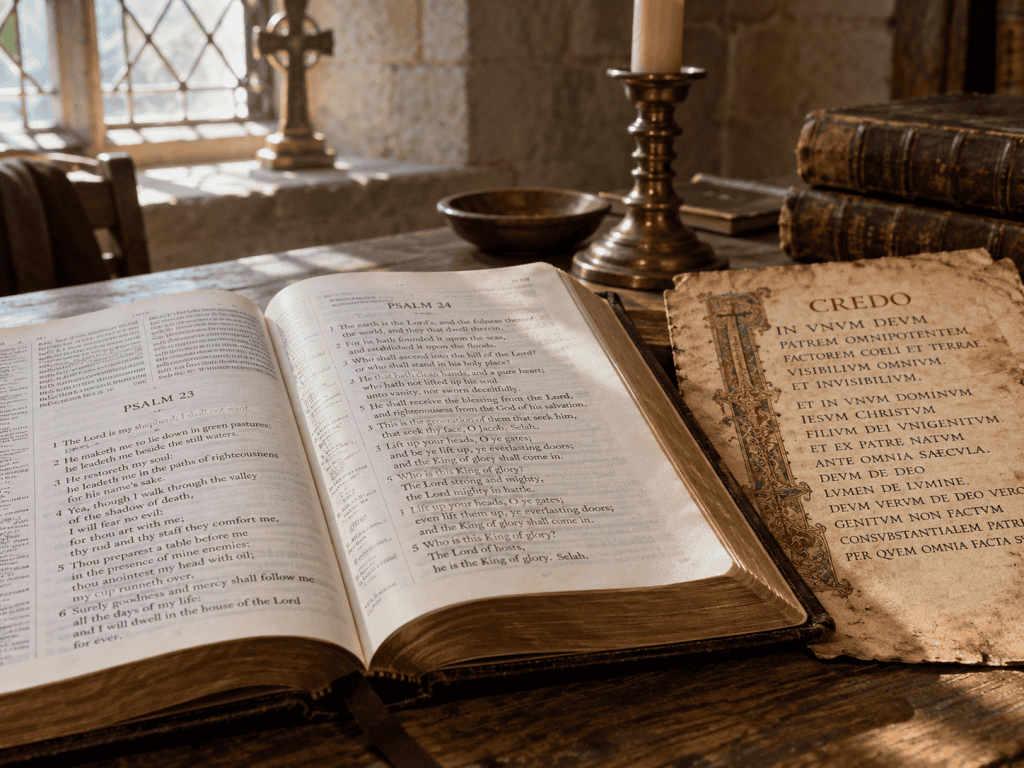
Creeds and confessions can be useful because they summarize how Christians have understood major biblical doctrines across generations. The Apostles’ Creed and the Nicene Creed, for example, give concise statements about God, Christ, the resurrection, and other central truths of the faith.
But a creed is not Scripture.
For Protestants, Scripture remains the final authority. Creeds and confessions can help us state doctrine carefully and show us where Christians have historically drawn important lines. They also remind us that we are not the first Christians to open the Bible and wrestle with these questions.
Still, every creed and confession must itself be tested by Scripture. What Christians have historically believed is worth paying attention to, but history does not settle the question. The final question remains: does Scripture teach it?
How Should You Test a Doctrine?
When you hear a doctrinal claim, especially one presented as something “the Bible clearly teaches,” work through a few basic questions.
- Read the passage in context. What is the writer actually saying in the surrounding verses and in the book as a whole?
- Compare Scripture with Scripture. Does the interpretation fit the rest of biblical teaching?
- Distinguish explicit teaching from inference. Is the doctrine stated directly, or are several passages being brought together to form a conclusion?
- Check your assumptions. Are you letting Scripture shape your theology, or asking Scripture to defend a system you already decided must be right?
- Ask how central the issue is. Does the doctrine concern God, Christ, the gospel, or another foundational truth, or is it a secondary question?
- Listen to the historic church without treating it as infallible. Centuries of Christian interpretation should not be dismissed lightly, but neither should tradition overrule Scripture.
- Be willing to be corrected. Sound doctrine requires humility because our theology must submit to God’s Word, not the other way around.
Biblical doctrine gives Christians something firmer than preference, tradition, or whatever teaching happens to be popular at the moment. It gives us a standard outside ourselves. That standard is Scripture.
The goal is not to make every Christian agree on every question. It is to recognize what God has clearly revealed and hold to it without apology. Secondary questions still deserve serious study, but we should know the difference between faithful disagreement and teaching that distorts the gospel.
FAQ
How Can I Tell Whether a Doctrine Is Biblical?
A doctrine is biblical when it comes from Scripture understood in its proper context and agrees with the teaching of Scripture as a whole. Quoting a verse is not enough if the interpretation ignores the passage around it or contradicts clearer biblical teaching elsewhere.
Is Every Doctrinal Error Heresy?
No. Christians can be genuinely wrong about a doctrine without denying the Christian faith. Heresy goes further by denying or corrupting truths at the foundation of Christianity, especially truths about God, Christ, and the gospel.
Are Creeds and Confessions Equal to Scripture?
No. Creeds and confessions summarize what Christians believe Scripture teaches, but they do not have the authority of Scripture itself. They can help Christians state doctrine carefully and learn from the historic church, but they must always remain subject to God’s Word.
Keep Reading
- Is Doctrine Important?
- 5 Essential Christian Beliefs Most Churches Won’t Teach
- Free Will vs Predestination: What the Bible Actually Teaches
- What Does the Bible Say About Women Preachers?
- What Must I Do to Be Saved? The Bible’s Clear Answer

Walt Roderick is a Christian writer who cares more about biblical clarity than online applause. He writes to strengthen believers and confront spiritual drift.