Divine Council in the Bible: What It Is, Where It Appears, and Who the Members Are
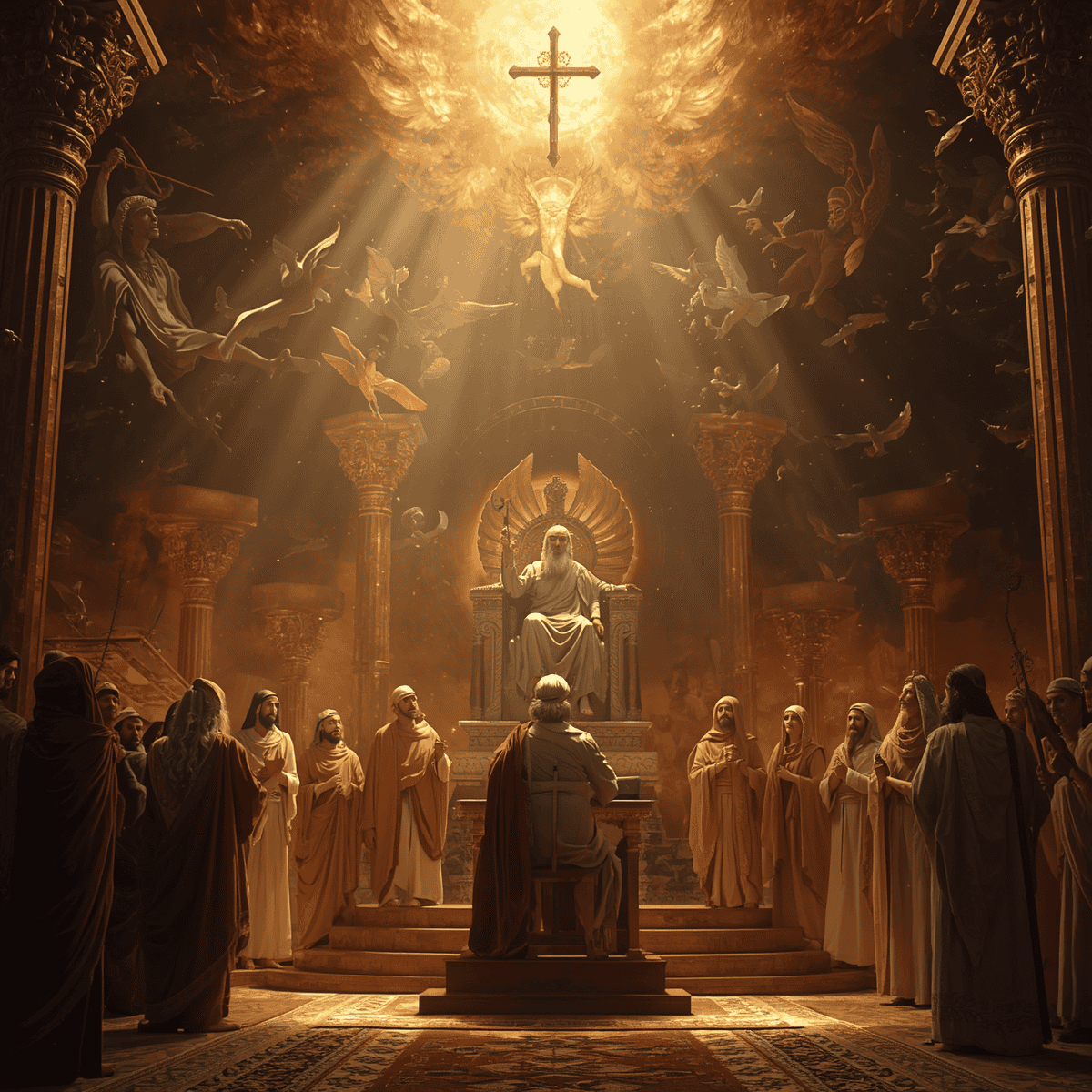
Psalm 82 is one of the strangest passages in the Bible to read cold. God is standing in an assembly, surrounded by other divine beings he calls elohim, and he is pronouncing judgment on them for failing in their responsibilities. The divine council in the Bible is that framework — the structure the biblical writers used to describe God’s heavenly court, and once you see it, passages that used to feel out of place start to make sense.
What Is the Divine Council in the Bible?
The divine council is the assembly of heavenly beings the biblical writers describe as serving under God’s authority — real created beings who carry out his decrees, appear in his presence, and govern aspects of his creation. Psalm 82:1 is the clearest window into how that structure works: “God presides in the great assembly; he renders judgment among the gods.” The word translated “gods” is the Hebrew elohim — the same word used for God himself throughout the Old Testament, which is exactly what makes this passage disorienting on a first reading.
The Hebrew term elohim does not function the way most English readers assume. It is not exclusively a name for the God of Israel. It is a category — a term that describes beings who inhabit the spiritual realm rather than the physical one. God is elohim. The beings in his heavenly court are also elohim. What separates them is not the word — it is what each being actually is.
God is uncreated, self-existent, and incomparable. The council members are created, dependent, and accountable to him. The term covers both because both inhabit the same category of existence — the spiritual realm — while being different in nature and power.
This is the framework Hebrew scholars use when they describe the divine council in the Bible. It is not a modern invention. It is the framework the biblical writers were working with when they wrote Psalm 82, Job 1, Daniel 10, and Psalm 89 — passages that become clearer once the category is understood. Michael Heiser’s The Unseen Realm made this framework accessible to a wider Christian audience, but the framework itself is in the text — and it raises a question most readers hit immediately: does a heavenly assembly of divine beings mean the Bible teaches polytheism?
Does the Divine Council Mean the Bible Teaches Polytheism?
No. The divine council does not make the Bible polytheistic. The council members are created — they exist because God made them. God stands in a category of his own — which is exactly what Isaiah 46:9 states: “I am God, and there is no other; I am God, and there is none like me.”
The council exists because God established it. Its members serve under his direction and answer to his authority. A court does not diminish the king. It extends his reach.
Psalm 82:6–7 makes this distinction concrete. God addresses the council members directly: “I said, ‘You are gods; you are all sons of the Most High.’ But you will die like mere mortals; you will fall like every other ruler.” God is not saying they are gods in any ultimate sense — he is saying they will die like humans. Created beings can die. God cannot. That is the line between monotheism and polytheism, and Psalm 82 draws it explicitly.
The confusion arises because English readers bring a Greek philosophical framework to a Hebrew text. In Greek thinking, “god” means a being of supreme and independent power — which is why having multiple gods creates a logical problem. In Hebrew thinking, elohim describes a category of being defined by the spiritual realm, not a level of ultimate power. The God of Israel is elohim in a category of his own — incomparable, uncreated, sovereign. The council members are elohim of a fundamentally different and lesser kind. The biblical writers held both of these things without contradiction because they were working with the Hebrew category, not the Greek one.
Where the Divine Council Appears in Scripture
The divine council appears across the Old Testament in the same pattern — God at the center of a heavenly assembly, with beings who govern, deliberate, and report.
Job 1–2 is the most extended scene. The sons of God present themselves before God, and among them is the Adversary — the satan figure — who has been roaming the earth and reporting back. These beings have access to God’s presence, give accounts of their activities, and God engages with each of them directly.
First Kings 22:19–22 shows the same structure in a different setting. The prophet Micaiah describes a vision of God seated on his throne with the host of heaven standing around him. God asks who will go and carry out a specific task, a spirit volunteers, and God commissions it.
Daniel 10 shows the council’s reach into the nations. An angelic figure tells Daniel that the prince of Persia opposed him for twenty-one days until Michael came to help. Princes — heavenly beings assigned to specific nations — appear as a structural feature of how God governs the world. The divine council in the Bible operates as a governing body with functional assignments across the earth, and Daniel 10 shows those assignments in operation.
Psalm 89:5–7 is where the biblical writers name the structure explicitly — not just show it: “The heavens praise your wonders, Lord, your faithfulness too, in the assembly of the holy ones. For who in the skies above can compare with the Lord? Who is like the Lord among the heavenly beings? In the council of the holy ones God is greatly feared; he is more awesome than all who surround him.”
That assembly is not a uniform body — it includes distinct categories of beings with different functions and different roles.
Who the Members Are
The bene ha-elohim — sons of God in Hebrew — is the category that appears most directly in the council scenes. They present themselves before God in Job 1, they are assigned to the nations in Deuteronomy 32, and they are the beings Genesis 6 identifies as crossing into the human realm in the most disruptive way Scripture records. The sons of God in the Bible covers their identity and role in full.
The Watchers are a specific subset — a category of heavenly being identified in Daniel 4 by the Aramaic term iyr, defined by their permanent state of vigilance and their role in executing God’s judgments against human kingdoms. Some of these beings remained faithful to that role. Others did not — abandoning their proper domain and facing the judgment described in Jude 1:6. The watchers in the Bible covers the rebellion and judgment in full.
The seraphim appear in Isaiah 6, surrounding God’s throne, covering their faces and feet in his presence, crying out his holiness. The cherubim appear in Ezekiel 1 and 10 as the living creatures beneath God’s throne — complex, powerful, serving as the foundation of his mobility across creation. The holy ones appear throughout the Psalms as the broader assembly surrounding God in his heavenly court.
Some of these beings remained in their proper roles. Some rebelled. The ones who rebelled produced consequences that run from Genesis 6 through the Nephilim and into the judgment passages of the New Testament.
What happened to those rebellious members — and how the whole structure of the divine council in the Bible connects to the nations, to Deuteronomy 32, and to what Jesus came to accomplish — is the next piece.

Walt Roderick is a Christian writer who cares more about biblical clarity than online applause. He writes to strengthen believers and confront spiritual drift.