Elders and Deacons: Who Leads the Church and Who Serves?
You can sit in a pew for twenty years and never really know why your church has both elders and deacons, why some churches have only deacons, or why the two offices do not do the same thing. The basic difference is straightforward: elders teach, shepherd, and exercise spiritual oversight, while deacons serve the church by handling practical ministry needs. Both are biblical offices, but they do not have the same authority or responsibility.
Elders vs. Deacons: What Is the Biblical Difference?
The difference between elders and deacons is not that one office matters and the other does not. The real question is what Christ gave each office to do. Elders are responsible for teaching, guarding doctrine, shepherding the congregation, and exercising spiritual oversight. Scripture gives deacons a distinct office without spelling out a universal list of duties. Acts 6 helps us see the pattern: the church can entrust tangible needs to qualified servants rather than allowing those needs to crowd out its ministry of prayer and the Word.
| Area | Elders | Deacons |
|---|---|---|
| Primary emphasis | Teaching, shepherding, and spiritual oversight | Organized service and practical care |
| Key passages | Acts 20:17–31; 1 Timothy 3:1–7; Titus 1:5–9; 1 Peter 5:1–4 | Philippians 1:1; 1 Timothy 3:8–13; Acts 6:1–7 as a likely prototype |
| Teaching requirement | Must be able to teach and defend sound doctrine | Not required as an office qualification |
| Governing responsibility | Exercise oversight and guide the congregation | Serve in entrusted ministries under the church’s governing leadership |
| Shared qualifications | Above reproach, faithful at home, and free from greed | Above reproach, faithful at home, and free from greed |
| Relationship to the church | Shepherd the congregation and watch over souls | Help ensure practical and mercy needs are served faithfully |
When elders get buried in day-to-day details, teaching, prayer, and shepherding are often the first things to suffer. When deacons are treated as junior elders or as a second governing board, the distinction Scripture gives us starts to disappear.
What Does the Bible Say About Elders?
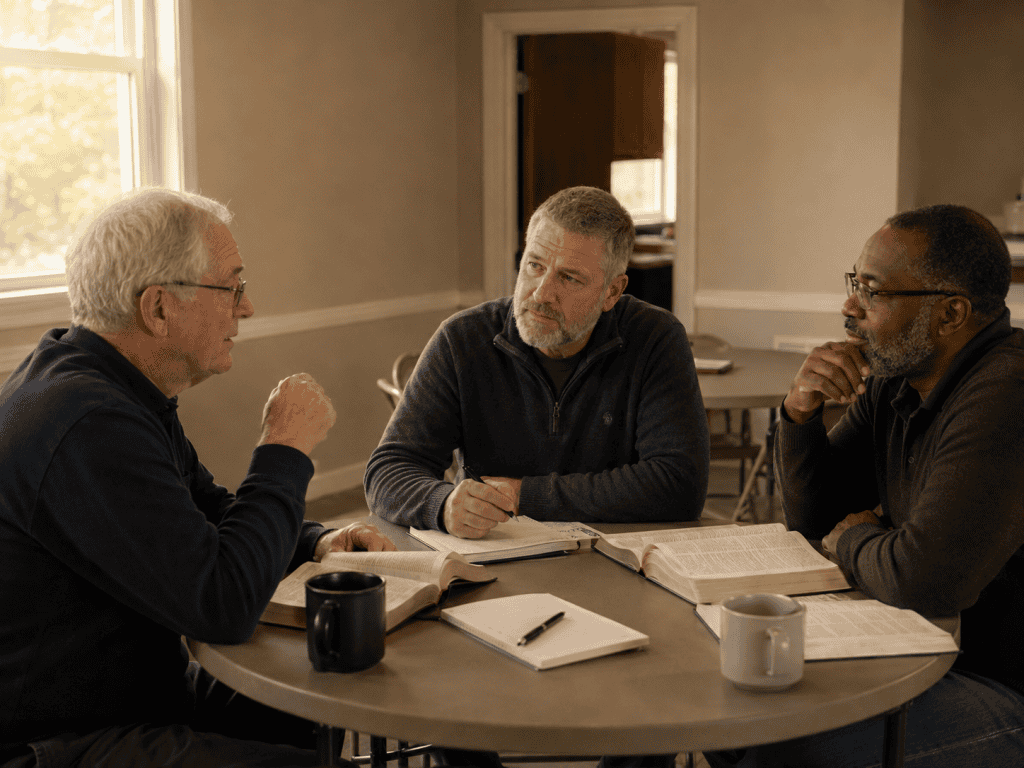
The office of elder appears throughout the New Testament. Paul tells Titus to appoint elders in every town (Titus 1:5), and 1 Timothy 3 lays out the qualifications for the office. An elder must be able to teach, hold firmly to sound doctrine, shepherd the people under his care, and protect the church from error. Paul warns the Ephesian elders to guard the flock against false teachers in Acts 20:28–31, and Titus 1:9 says an overseer must be able to exhort in sound doctrine and refute those who contradict it.
An elder is not simply a man who sits on a board and helps make decisions. Elders are charged with the spiritual care of the congregation. Their work includes teaching, prayer, shepherding, guarding doctrine, and exercising oversight under Christ, who alone is Head of the church.
Are Pastor, Elder, and Overseer the Same Office?
The New Testament uses elder, overseer, and shepherding language for the same men, which is why I understand pastor, elder, and overseer as descriptions of one office rather than three levels of authority. The Greek terms presbyteros (“elder”) and episkopos (“overseer”) emphasize different aspects of the same office.
| Passage | Language Used | What It Shows |
|---|---|---|
| Acts 20:17, 28 | Elders, overseers, shepherding | Paul summons the elders, then tells those same men that the Holy Spirit made them overseers to shepherd the church |
| Titus 1:5, 7 | Elders, overseer | Paul moves from appointing elders to describing the qualifications of an overseer |
| 1 Peter 5:1–2 | Elders, shepherding, oversight | Peter tells the elders to shepherd God’s flock while exercising oversight |
Those titles are not three rungs on a church ladder. Scripture calls these men elders when emphasizing who they are, overseers when emphasizing the responsibility entrusted to them, and shepherds when describing their care for Christ’s flock. The 1689 London Baptist Confession reflects the same two-office understanding when it identifies the continuing officers of the local church as overseers or elders, along with deacons.
What Does the Bible Say About Deacons?

Deacons appear differently. Acts 6 describes a practical problem in the growing Jerusalem church: widows were being overlooked in the daily distribution of food. The apostles refused to neglect prayer and the ministry of the Word in order to manage the problem, so the church selected qualified men to take responsibility for it.
Luke never formally calls the Seven deacons, so Acts 6 should not be treated as though the office is explicitly named there. What the passage does show is a church setting apart qualified men to solve a concrete ministry problem while the apostles remain devoted to their calling. So Acts 6 helps us understand the kind of work deacons do without pretending Luke actually gives the Seven that title.
The Greek word diakonos can mean servant or minister, depending on the context. By Philippians 1:1 and 1 Timothy 3:8–13, deacon is clearly a recognized church office with its own qualifications. Deacons are not required to be able to teach the way elders are, and Scripture does not assign them the shepherding and governing oversight given to elders.
Are Deacons Church Leaders?
Deacons hold a biblical office, but they are not part of the church’s governing and shepherding leadership in the same sense as elders. Scripture gives elders responsibility for teaching, doctrine, oversight, and care of the flock. It gives deacons qualifications for faithful service without assigning them that governing role.
That does not make deacons less important. Scripture gives real qualifications for the office. But serving faithfully is not the same thing as governing the church. A church can honor its deacons without turning them into junior elders.
Why Do Some Churches Have Only Deacons?
Churches use different titles, and the title does not always tell you what a man actually does. Some Baptist churches call their governing men deacons even when those men perform responsibilities the New Testament assigns to elders. Other churches may have both offices on paper but have never clearly explained the distinction to the congregation.
A young or rebuilding church may also lack enough qualified men to fill both offices. Scripture never tells a church to lower the qualifications because an office is empty. If qualified elders are not yet available, the answer is to pray, disciple men, and wait for the Lord to raise them up rather than appointing someone simply because the position needs to be filled.
The title on the church website is not the main issue. What matters is whether qualified men are doing the work Scripture assigns. Someone must teach sound doctrine, shepherd the congregation, and exercise spiritual oversight. The church’s practical needs must also be met, but those needs should not redefine the elder’s calling.
What If Deacons Govern the Church?
If men called deacons are deciding doctrine, directing the spiritual life of the congregation, supervising the pastor, or exercising ongoing shepherding authority, the real question is whether they are functioning as elders regardless of the title the church gives them. Calling a man a deacon does not make governing oversight a diaconal responsibility.
That does not mean every administrative decision belongs to the elders. Churches will organize practical responsibilities differently. But when the deacon board governs the church and the pastor mainly works for the board, the church has reversed the roles Scripture gives them.
Does the Bible Teach a Plurality of Elders?
The New Testament normally presents elders in the plural. Paul and Barnabas appointed “elders for them in every church” in Acts 14:23. Paul called for the elders of the Ephesian church in Acts 20:17. Titus was told to appoint elders in every town, and James told a sick believer to call for the elders of the church. The repeated pattern is more than one qualified man sharing responsibility for shepherding and oversight.
Plurality also has practical wisdom. It provides accountability and keeps the full weight of shepherding from resting on one man. That does not mean every elder has the same gifts or spends the same amount of time preaching. First Timothy 5:17 recognizes that some elders labor especially in preaching and teaching. Acts 20 and 1 Peter 5 still place shepherding and oversight on the elders as a body.
A church may not immediately have several qualified men ready to serve. That does not erase the New Testament pattern, but neither does it justify filling the office with men who are not qualified.
Qualifications for Elders and Deacons
Paul lays out qualifications for both elders and deacons in 1 Timothy 3, and the overlap is striking. Character comes first. Both offices require men whose lives are above reproach, who are faithful at home, and who are not ruled by greed or alcohol.
One qualification tells us a great deal about the elder’s work: he must be able to teach. Titus 1:9 explains why. He has to know the truth well enough both to encourage the church with sound doctrine and to answer those who oppose it. Deacons also have to hold firmly to the faith, but Paul never makes teaching ability a qualification for their office. That difference matters because the two offices are not interchangeable.
These qualifications also show that church office is not awarded because a man is successful in business, popular, forceful, or influential. Competence matters, but Scripture begins with proven character, spiritual maturity, faithfulness at home, and a life that can withstand examination. None of this requires sinless perfection. It describes the settled pattern of a man’s life.
Does Your Church Follow the Biblical Pattern?
This is where the distinction between elders and deacons stops being a technical church-government discussion. The question is whether your own church is actually doing what Scripture describes.
Ask a few basic questions about your own church:
- Who is responsible for teaching and guarding sound doctrine?
- Who actually shepherds the members of the congregation?
- Who exercises spiritual oversight?
- Are the deacons serving the church’s practical needs, or are they functioning as its governing board?
- Is one pastor carrying responsibilities the New Testament normally shows shared among elders?
- Are the men holding office biblically qualified, or were they chosen mainly because they are successful, popular, or willing?
- Do the titles your church uses match what those men actually do?
This is not about forcing every faithful church into the same organizational chart. It is about letting Scripture, not church tradition, decide who is supposed to do what. Christ is Head of the church, and the responsibilities He gives to both offices are part of how His church is ordered.
If you are part of a local church, it is worth knowing who holds each office, what those men are actually responsible for, and whether your church is living out the distinction Scripture gives. That is part of actually belonging to a church, not just showing up on Sunday.
Keep Reading in This Series
- What Is the Church? A Biblical Definition of Ekklesia
- Understanding Government Authority Over the Church in Light of Scripture
- Why Do I Need to Attend Church?
Frequently Asked Questions About Elders and Deacons
What Is the Main Difference Between Elders and Deacons?
Elders teach, shepherd, guard doctrine, and exercise spiritual oversight. Deacons hold a service-oriented office that helps ensure the church’s practical and mercy needs are handled faithfully.
Are Pastors and Elders the Same Office?
Yes. The New Testament uses elder, overseer, and shepherding language for the same men in passages such as Acts 20:17, 28; Titus 1:5, 7; and 1 Peter 5:1–2. The terms emphasize different aspects of the same pastoral office rather than separate levels of authority.
Are Deacons Church Leaders?
Deacons are recognized church officers, but Scripture does not give them the teaching, shepherding, and governing oversight assigned to elders. Their office is centered on faithful service rather than governing the congregation.
Can a Church Have Deacons but No Elders?
A church may temporarily lack qualified elders or use different titles, but the responsibilities Scripture assigns to elders do not disappear. Qualified men still need to teach sound doctrine, shepherd the congregation, and exercise spiritual oversight.
Can Women Serve as Deacons?
Christians disagree over passages such as Romans 16:1 and 1 Timothy 3:11. Even if Phoebe is understood as holding the office of deacon, that does not make her a pastor or elder because the deacon’s office is not the governing and teaching office Scripture assigns to elders.

Walt Roderick is a Christian writer who cares more about biblical clarity than online applause. He writes to strengthen believers and confront spiritual drift.