Rephaim in the Bible: Giants, the Underworld, and What Scripture Actually Says
Scripture uses one Hebrew word, Rephaim, for two things that don’t seem to belong together — a race of unusually large warriors, and, in several poetic passages, the spirits of the dead in Sheol. Many scholars believe those two uses are intentionally connected, though others see them as separate developments of the same Hebrew word. Understanding both uses is essential to understanding how the Old Testament employs the term. The Rephaim in the Bible show up from Abraham’s day all the way to David’s, and understanding both senses of the word is the only way to read those passages — from Genesis 14 to the giants of Gath — the way they were meant to be read.
Who Were the Rephaim in the Bible?
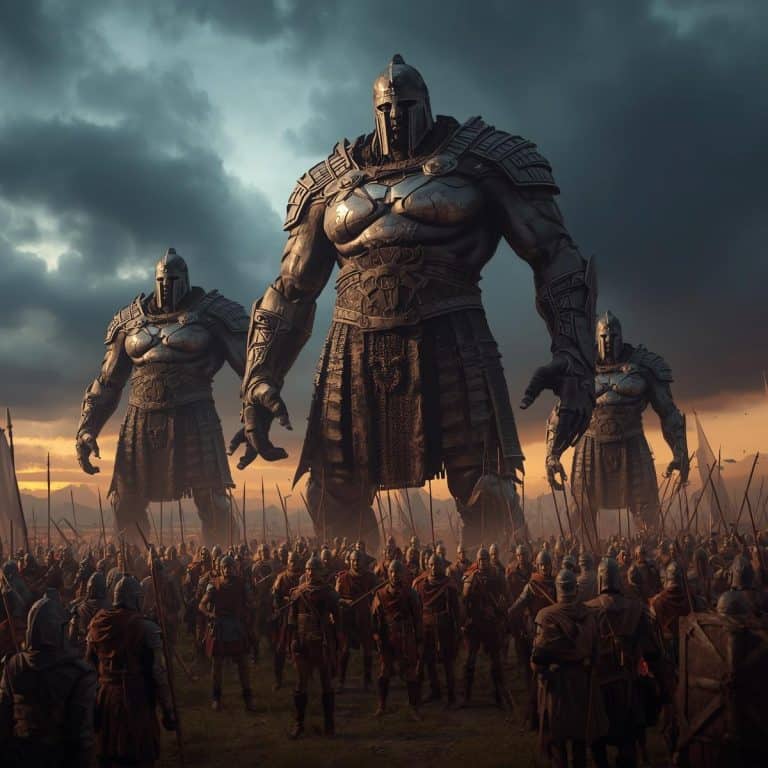
Before anything else, the Rephaim in the Bible were a people — a clan or coalition of unusually tall, physically imposing inhabitants of the land east and west of the Jordan. Deuteronomy 2:10-11 describes the Emim, who lived in Moab before Israel arrived, as “a people great and many, and tall as the Anakim,” adding that “like the Anakim they are also counted as Rephaim.” A few verses later, the same chapter applies the label to the Zamzummim in Ammonite territory (Deuteronomy 2:20-21).
Emim, Zamzummim, and Anakim appear to represent closely related giant peoples. Scripture repeatedly groups them together with the Rephaim, although it never explicitly says they were all branches of a single bloodline. Among them, Og, king of Bashan, is the most famous individual figure, whose enormous iron bed — about thirteen and a half feet long — gets specific mention in Deuteronomy 3:11, which says “only Og the king of Bashan was left of the remnant of the Rephaim.” Joshua 12:4 and 13:12 confirm the same identification, naming him “one of the remnant of the Rephaim.”
These aren’t legendary asides. They’re treated in the text the same way Israel’s other real, named enemies are treated — defeated in real battles, occupying real territory, remembered by name generations later, the way Scripture also remembers the mighty men of old from the pre-flood era. That raises an obvious question, since Scripture also describes a group of giants back in Genesis 6 — are the Rephaim just another name for the Nephilim?
Are the Rephaim the Same as the Nephilim?
Not exactly. The Nephilim appear specifically in a pre-flood context in Genesis 6, tied to the union between the sons of God and human women. The Rephaim are a broader and longer-running designation — a named people group that continues to appear for centuries after the flood, right through the conquest and into the era of King David.
Numbers 13:33 does connect the two traditions, when the spies report seeing Nephilim in Canaan and identify the Anakim as descended from them — and the Anakim, in turn, are repeatedly linked to the Rephaim. So the categories overlap and share a common thread of unusual size, ancient origin, and opposition to God’s people, but Rephaim is the term Scripture actually uses for the ongoing clan, while Nephilim names something more specific to the world before the flood.
Why Does the Bible Call the Rephaim Both Giants and Spirits of the Dead?
The word carries a second meaning that has nothing to do with genealogy. The same Hebrew word, Rephaim, also names the dead in several poetic and prophetic texts — and this is where the article’s opening claim earns its keep. Job 26:5 says “the dead tremble under the waters and their inhabitants” — and in the Hebrew, “the dead” here is Rephaim.
Psalm 88:10 asks, “Do you work wonders for the dead? Do the departed rise up to praise you?” — again, Rephaim. And Isaiah 14:9 describes Sheol as being “stirred up to meet you when you come,” rousing “the shades to greet you, all who were leaders of the earth” — a taunt against the fallen king of Babylon, and the same word once more.
Many scholars see this as deliberate rather than coincidental. Old Testament scholar Richard Hess, reviewing Jonathan Yogev’s study of the Rephaim in Ugaritic and biblical texts, notes that the wider ancient Near Eastern evidence — from Ugarit, the Amorite world, and Phoenicia — consistently associates figures called Rapiuma or Rapi’u with royal ancestors and the underworld, sometimes portrayed as venerable, sometimes as figures a king joins in death.
Not every scholar agrees the connection is intentional; some treat the giant-clan sense and the underworld-spirits sense as separate developments that happened to converge in the same Hebrew word. But on the reading that takes the overlap as deliberate, Scripture gives the shared word a harder edge than its Ugaritic background: the Rephaim in the Bible are not honored ancestors to be joined in glory.
They are the dead who oppose God, described elsewhere as having no hope of rising (Isaiah 26:14). Read this way, the giant clans who fought Israel and the dead who tremble beneath the earth are, in the text’s own vocabulary, the same word — a connection that carries real theological weight, whatever the biblical authors’ intent. Seen against the wider divine council framework running through the Old Testament, the Rephaim aren’t an isolated curiosity — they’re one more thread in a much larger pattern of rebellion, judgment, and the boundary between the human and heavenly realms.
Where Did the Rephaim Live?
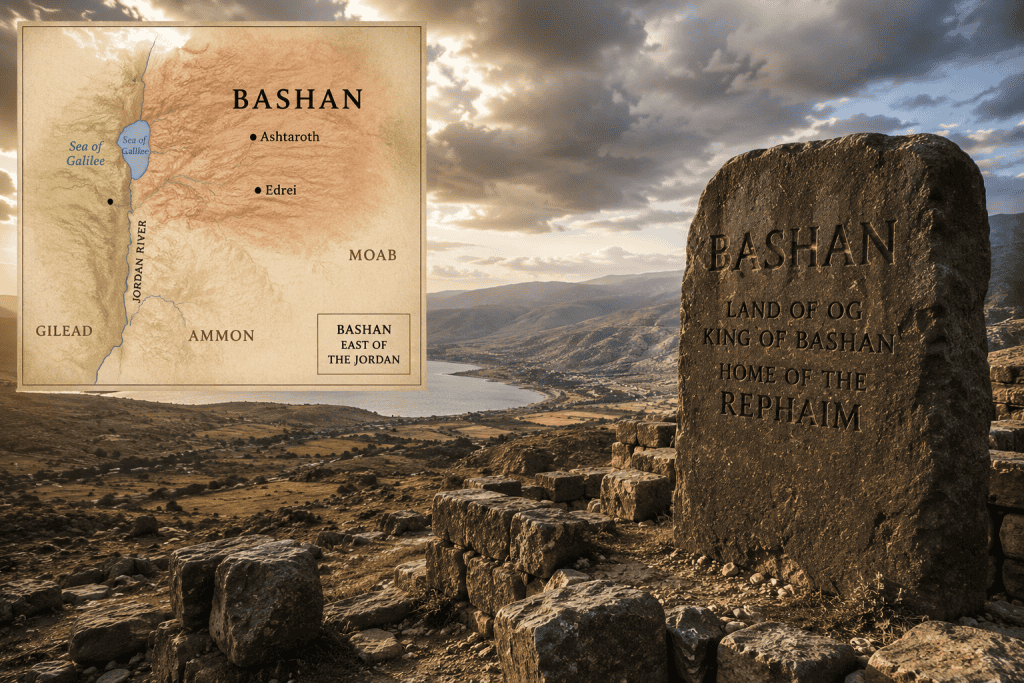
The core territory of the Rephaim in the Bible was Bashan, the region east of the Jordan ruled by Og before Israel’s conquest. Some scholars connect this to the wider Ugaritic tradition, where the god Ilu is associated with the same region — one more thread in the broader Bashan-Rapiuma connection that Hess and Yogev discuss, though the specific Ashtaroth and Edrei detail is not as firmly established as the general regional link.
This giant-clan tradition reaches back as early as Genesis 14, during Abraham’s lifetime, when the invading eastern kings strike the Rephaim in Ashteroth-Karnaim on their way toward Sodom — placing it at the very start of the patriarchal narrative, centuries before the conquest. A second Rephaim territory shows up west of the Jordan: the Valley of Rephaim, a real location just southwest of Jerusalem, named eight times in Scripture (Joshua 15:8; 18:16; 2 Samuel 5:18, 22; 23:13; 1 Chronicles 11:15; 14:9; Isaiah 17:5). David fought the Philistines there twice early in his reign — the same valley, carrying the same name, centuries after Bashan’s Rephaim had already fallen.
Was Goliath a Descendant of the Rephaim?
By David’s time, the Bashan and Jerusalem branches of the Rephaim in the Bible were long gone — but one more pocket remained, in Philistine territory. Scripture never calls Goliath himself a Rephaim by name, but his family line is a different matter. Second Samuel 21:15-22 lists four Philistine warriors from Gath, killed in later battles by David’s men, and explicitly identifies them as “descended from the giants in Gath” — including Ishbi-benob, named in verse 16 as “one of the descendants of Rapha,” the same root as Rephaim. First Chronicles 20:4-8 repeats the same genealogy. Whatever the exact bloodline, Goliath walks onto the battlefield in 1 Samuel 17 carrying the last real echo of a tradition Scripture had been tracking since Abraham’s day — the same lineage traced in more detail in Was Goliath a Nephilim?
FAQ
Are the Rephaim the same as the Nephilim?
Not precisely. The Nephilim are named specifically before the flood in Genesis 6, while the Rephaim in the Bible are a broader clan designation that continues for centuries afterward. Numbers 13:33 links the two traditions through the Anakim, but Rephaim is the term Scripture uses for the people group itself.
Was Goliath a Nephilim or a Rephaim?
Scripture doesn’t apply either label to Goliath directly. What it does say is that his fellow warriors from Gath were descendants of Rapha, the same root behind Rephaim (2 Samuel 21; 1 Chronicles 20) — enough to place him in that lineage without a formal title attached.
Keep Reading in This Series
- Nephilim in the Bible
- Divine Council in the Bible
- Mighty Men of Old: Understanding Genesis 6’s Most Mysterious Figures

Walt Roderick is a Christian writer who cares more about biblical clarity than online applause. He writes to strengthen believers and confront spiritual drift.